The Complete Guide to Necklace Chains: Types, Lengths & How to Choose

This post may contain affiliate links. Read our affiliate policy
A chain is the one piece of jewelry most people buy blind. The listing says "18 inches, 2mm, 14k," and none of those numbers tell you whether it will sit where you want, hold your pendant without flipping it, or survive a year of being pulled over your head. This necklace chain guide translates the specs into decisions: which constructions last, how length actually falls on a body, and what to check before you spend.
We are not going to pretend every chain is a good chain. Some popular styles kink easily, and once creased they are difficult to repair without leaving a weak spot. Knowing which is the difference between a purchase and a write-off.
Table of Contents
- What Actually Matters When You Buy a Chain
- Necklace Chain Types, Link by Link
- Chain Length: Finding Your Number
- Chain Width and Gauge: How Thick Is Right
- Matching a Chain to a Pendant
- Chains Built for Everyday Wear
- Clasps: The Part That Fails First
- Tangles, Knots and How to Prevent Them
- When a Chain Breaks: Repair or Replace
- Chains for Men: Width, Length and Proportion
- Sterling Silver Chains Worth Buying
- Layering Multiple Chains
- FAQ
What Actually Matters When You Buy a Chain
Four variables decide whether a chain works: construction (how the links are made and joined), length, width, and metal. Everything else is styling.
Construction determines durability. A chain made of individually soldered links behaves nothing like a chain made from a folded, compressed metal ribbon, even at the same width and price. Solder, if the word is new to you, is the filler alloy a jeweler melts to fuse two pieces of metal; a soldered link is a closed link, and closed links are what keep a chain on your neck.
Metal determines cost, color, and how the chain ages. Karat is simply the proportion of pure gold in an alloy out of 24 parts. According to Quantum Qarat's hallmark guide, a 14K stamp means the piece is 58.3% pure gold by weight, with the remaining 41.7% typically copper, silver, or other metals added for durability, and that 585 is the European equivalent mark for the same gold content. Jewelers Mutual's guide to gold markings covers the other end of the scale: 750 is the European mark for 18K, or 75% pure gold. On the silver side, Jewelry Auctioned's hallmark reference explains that a 925 stamp indicates 92.5% pure silver, with the balance alloyed in for strength. If you want the full comparison of gold karats, platinum, sterling, and the alternative metals, our guide to jewelry metals covers how each one wears.
Two more things worth settling before you shop. First, plating is not a metal choice, it is a coating with an expiration date, and we cover the difference below. Second, if base-metal alloys have ever left a red mark or an itch on your skin, read our notes on nickel sensitivity and hypoallergenic metals before you buy anything unstamped. A chain sits against the skin all day, and it does not get a rest the way a ring or an earring does. For a deeper look at what the word gold is doing in a listing — karat versus construction, solid versus filled versus plated — see our guide to gold chain necklaces.
Necklace Chain Types, Link by Link
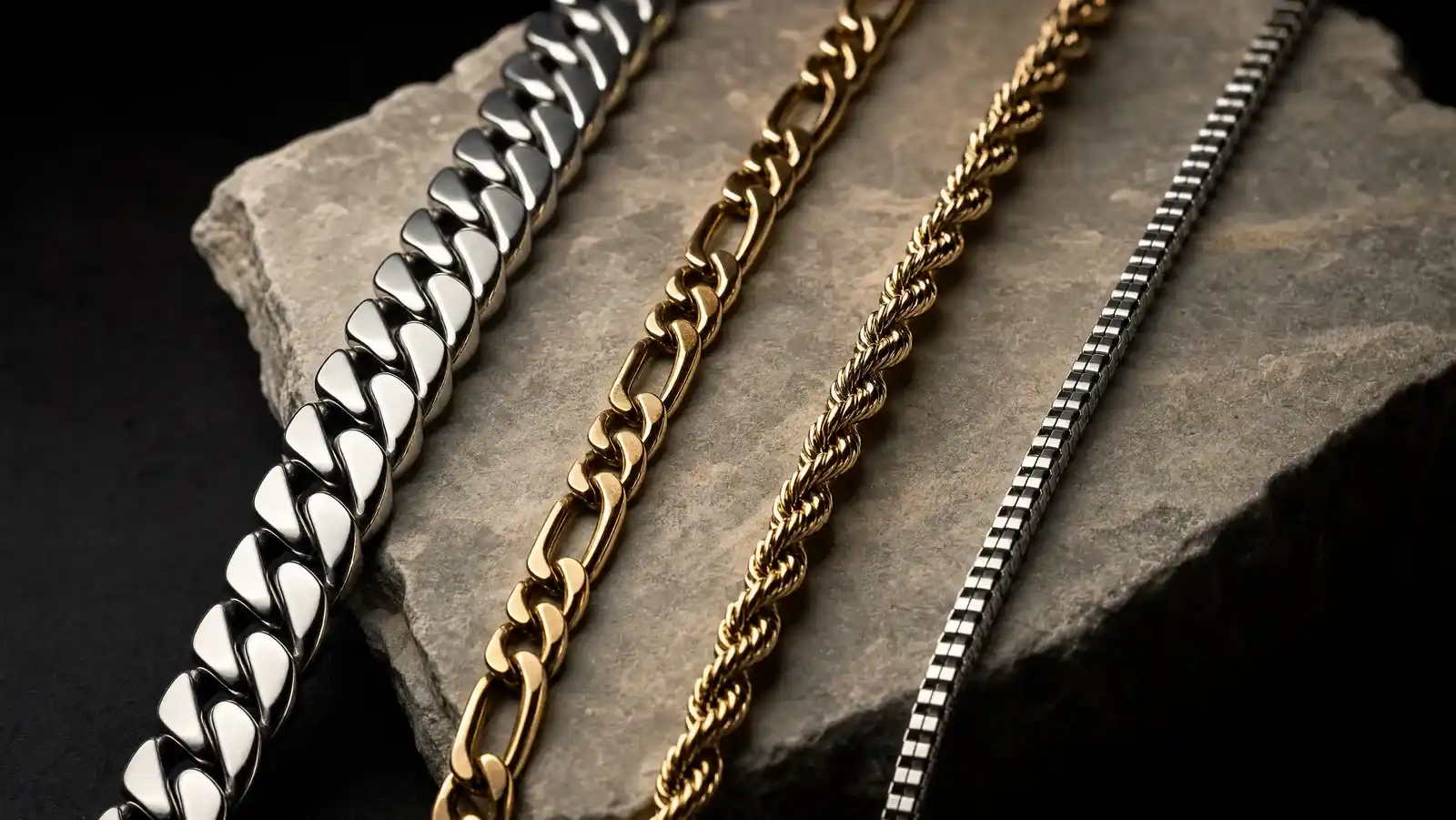
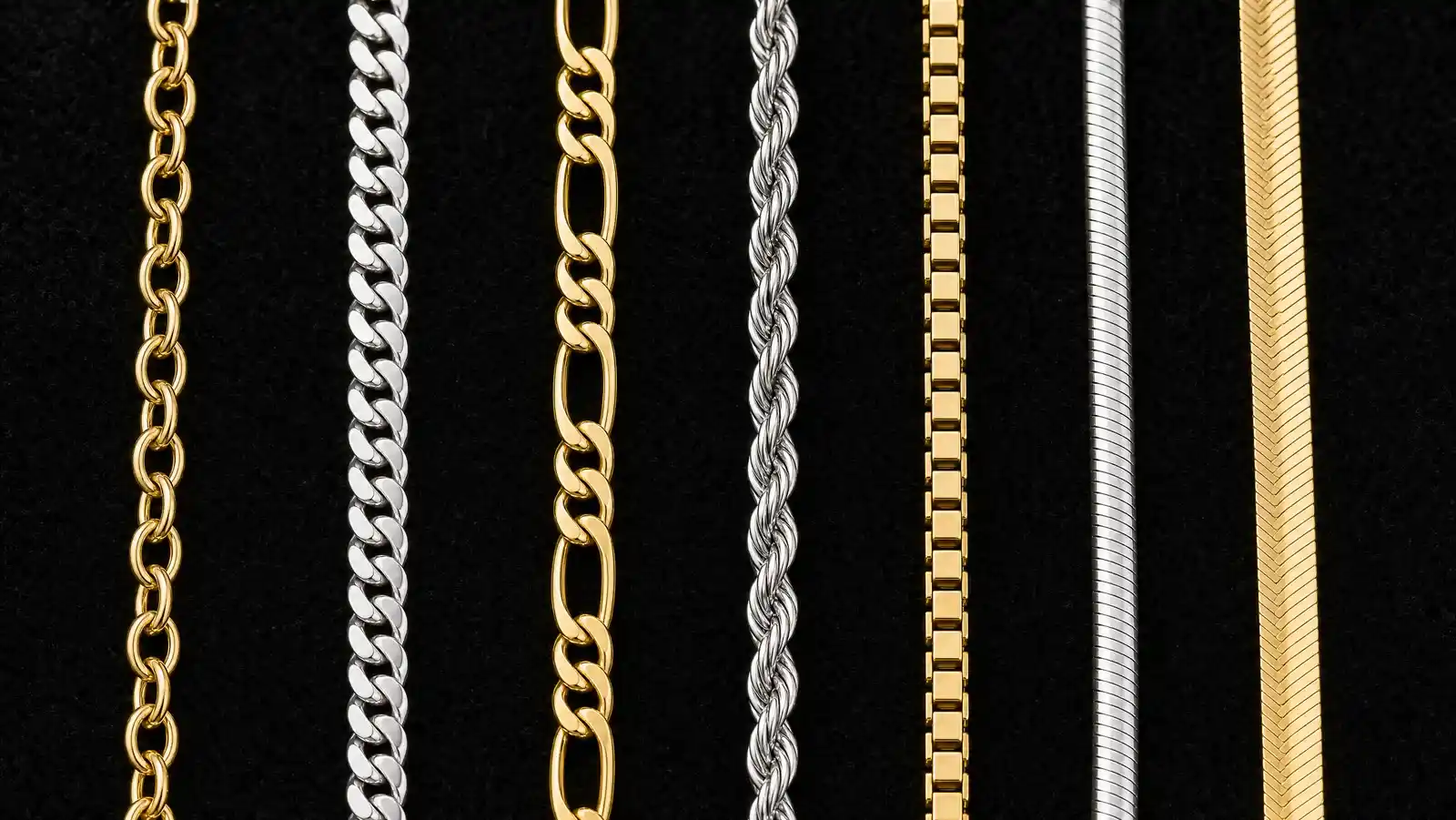
Chain names describe how the metal is formed and joined, not how it looks from three feet away. Here is the survey. This is deliberately compressed, because the full breakdown of necklace chain types deserves its own article with photographs of each construction at real size.
| Chain | How it is built | Holds a pendant | Everyday verdict |
|---|---|---|---|
| Cable | Uniform oval links, each set at 90 degrees to the last | Yes, sits flat | The default. Hard to go wrong |
| Rolo | Like cable, but with round, symmetrical links | Yes | Sturdy, slightly more visual texture |
| Curb / Cuban | Flattened, twisted links that lie flush | Yes | Very strong for its weight |
| Figaro | Curb links in a repeating pattern of one long, two or three short | Yes | Strong, more decorative |
| Rope | Multiple small links twisted into a spiral | Yes | Excellent when solid; hollow versions crimp |
| Box | Square links forming a smooth, four-sided cord | Yes | Neat, holds shape well |
| Wheat / Spiga | Four twisted oval strands woven in one direction | Yes | Dense and durable |
| Mariner / Anchor | Oval links with a bar across the center | Yes | Robust, nautical look |
| Byzantine | Complex interwoven link clusters | Yes | Heavy, expensive, very secure |
| Snake | Tightly compressed plates forming a flexible tube | Light pendants only | Kinks; treat gently |
| Herringbone | Flat, slanted links forming a liquid metal ribbon | No, wear alone | Beautiful, fragile |
| Singapore | Twisted cable that catches light along its length | Light to medium | Prone to knotting when thin |
| Bead / Ball | Small spheres joined by short connector bars | Light pendants only | Casual; connectors are the weak point |
The pattern is consistent: chains built from discrete, closed links are more forgiving than chains built from folded or compressed sheet. Robinson's Jewelers, in its comparison of chain strength, names wheat, Figaro, Cuban link, box, and rope as the strongest styles, describing the box chain as resistant to twisting and breaking and ideal for showcasing pendants securely.
Chain Length: Finding Your Number
Necklace chain length is measured end to end with the clasp included, which is why an 18-inch chain does not give you 18 inches of visible metal once it is fastened. The traditional length names are worth learning because catalogs still use them.
According to Statement Collective's necklace length chart, the six conventional categories are collar (14 inches), choker (16 inches), princess (18 inches), matinee (20 to 24 inches), opera (28 to 36 inches), and rope (36 inches and longer), and it notes that the industry standard is to measure end to end with the clasp included.
| Name | Length | Where it falls |
|---|---|---|
| Collar | 14 in | Around the base of the neck |
| Choker | 16 in | At or just above the collarbone |
| Princess | 18 in | Just below the collarbone |
| Matinee | 20 to 24 in | Upper chest |
| Opera | 28 to 36 in | Lower chest, or doubled |
| Rope | 36 in and up | Waist, or worn in multiples |
Princess at 18 inches is the default for a reason. The same reference describes it as falling just below the collarbone and calls it the most popular length there is, which makes it the standard home for a focal pendant. Matinee lengths earn their keep over crew necks and turtlenecks, where a collarbone-length chain simply disappears into fabric.
The reliable way to find your number is to take a soft tape measure, close it at the length you are considering, and look in a mirror before you buy. Neck circumference, height, and chest depth all move the drop point. A 16-inch choker that sits neatly on one person can sit tight on another. For the full tape-measure method, the neckline pairings, and how to adjust lengths for layering, our necklace chain length guide goes further.
Chain Width and Gauge: How Thick Is Right
Chain thickness is quoted as width — the millimeter number in the listing, measured across the widest point of the chain. Gauge is a related but different idea borrowed from wire manufacturing, describing the thickness of the wire the links are drawn from, where a lower gauge number means thicker wire. Retailers almost always publish width in millimeters, so that is the number to shop by.
According to Robinson's Jewelers' pendant thickness guide, 1mm to 2mm suits a tiny solitaire pendant, a floating gemstone, or a subtle charm; 3mm to 5mm is what it calls the most versatile range for pendant chains, appropriate for a medium-sized cross, a locket, or a gemstone pendant; and 6mm and wider is for heavy pieces such as large medallions, chunky dog tags, or signet-style pendants. A 1mm chain reads as a fine line and is best kept for delicate pendants or as a layering strand.
A second way to size the same decision is by pendant weight. La Fille Du Sud's chain-selection guide suggests roughly 0.8mm to 1.3mm for a pendant under one gram, 1.5mm to 3mm for a pendant of one to four grams, and more than 3mm for anything above four grams.
Two things width does that nobody mentions. A wider chain has more visual mass, so it reads shorter than a fine chain of the same stated length. And width is not the same as substance: a hollow 4mm chain can weigh less and dent more easily than a solid 2mm one. Ask whether a chain is solid or hollow before you compare millimeters. We treat chain thickness and gauge in detail separately, including how width interacts with clasp size.
Matching a Chain to a Pendant
A pendant and a chain are a system. Get the pairing wrong and the pendant flips, the chain distorts, or the two simply do not fit together.
Run four checks:
- Measure the bail. The bail is the loop or tube on the back or top of a pendant that the chain passes through. Robinson's pendant guide is blunt about this: threading a 5mm chain through a bail meant for a 2mm chain will not work. Check the bail opening before you check anything else.
- Match weight to strength. A heavy pendant on a fine chain concentrates load at the bail contact point and at the jump rings. Size up in width, or choose a construction with closed, soldered links.
- Choose a chain that resists twisting. Curb, cable, and box chains sit flat and keep a pendant facing forward. Fine twisted chains and thin snake chains rotate.
- Decide the drop. The pendant hangs below the chain's resting point, so a large pendant on an 18-inch chain lands lower than you may picture. Add the pendant's height to the drop when you visualize it.
There is more to say about how to pick a chain for a pendant, from slider bails to enhancer bails to converting a pendant between chains. For a sense of how pendant and chain proportions play out in finished pieces, our pendant necklace roundup is a useful visual reference.
Chains Built for Everyday Wear
Everyday means eight to sixteen hours a day, through sweaters, seatbelts, and sleep if you never take it off. That is a mechanical problem, not an aesthetic one.
If you want the shortlist, the chains we recommend for everyday wear are solid cable, solid curb or Cuban, box, wheat, and solid rope. Robinson's Jewelers names the Cuban link as one of the strongest chain styles available, crediting its thick, interlocking links, and describes the box chain as resistant to twisting and breaking. It also calls the wheat chain one of the most durable and flexible styles, noting that it resists kinking, and rates the rope chain among the most resilient.
Two specification-level rules matter more than the style name:
- Solid beats hollow. Learning Jewelry's chain durability guide puts a solid box chain at a 250 lb tensile rating and says hollow versions cut weight and cost but sacrifice about 40% of that durability. Hollow chains buy visual width cheaply and pay for it in dents.
- Lower karat is harder. The same guide points out that 10K gold's harder alloy maximizes a rope chain's strength, and that 18K's higher purity makes it softer than lower-karat options. For a chain you never take off, 14K is usually the better structural choice than 18K.
On water: the honest answer is to take it off. TrueFacet's guide to shower-safe jewelry advises that sterling silver is not ideal for shower use because it tarnishes when exposed to water, especially chlorinated or salt water, and that soap, hard-water minerals, and chlorine speed tarnish and can weaken soldered links. Gold alloys fare better than silver and far better than plating, but chlorine and salt remain the two exposures to avoid. When a chain does need attention, our guide to cleaning gold, platinum, and silver at home covers the safe methods.
Clasps: The Part That Fails First
Chains rarely fail in the middle. They fail at the clasp, the jump ring next to it, or the spring inside it, and a good chain with a cheap clasp is a chain you will lose.
The two you will meet constantly are the spring ring and the lobster claw. A spring ring is a hollow circle with a small lever and an internal coil spring. A lobster claw is a hinged, pincer-shaped gate with a stronger spring and a wider throat.
The lobster wins on nearly every measure. Robinson's Jewelers' clasp comparison notes that a lobster's spring mechanism means it does not accidentally open, making it suited to heavier pieces, and that it is easier to operate than many other clasps, while a spring ring's tiny spring can wear out over time. Clasp manufacturer Carol Metal puts standard lobster designs in a 5 to 10 kilogram load range, well above what most spring rings handle. The spring ring's failure mode is predictable: the coil loses tension over time, particularly on inexpensive examples, and a clasp that no longer springs shut is a clasp that opens on its own.
That said, a spring ring is smaller and less visually obtrusive, which is why it persists on fine, lightweight chains where a lobster claw would look like a bolt.
What to inspect before you buy or after a year of wear:
- Does the gate snap shut crisply, or does it drag and stall
- Is the jump ring connecting the clasp to the chain soldered closed, or just bent shut
- Is the spring visible and gritty, a sign of wear or corrosion
- Is the clasp proportionate to the chain's weight
For heavy pendants or valuable chains, a box clasp with a safety catch or a large lobster is the sensible upgrade. Beyond these three, a closer look at necklace clasp types covers toggles, magnetic closures, S-hooks, and barrel clasps, and where each one is and is not appropriate.
Tangles, Knots and How to Prevent Them
A knot is a mechanical event, not bad luck. Fine chains tangle because a loose chain forms coils, coils cross, and one end works through the loop. Prevention is almost entirely a storage problem.
Store chains hanging or laid flat and fastened. Clasping a chain before you put it away removes the free end that starts most knots. Individual pouches or compartments stop chains from finding each other. For travel, our jewelry storage and travel protection guide covers roll cases, hanging organizers, and the drinking-straw trick for fine chains.
A herringbone chain and a snake chain have a separate storage rule: store them flat, never coiled tightly, because their construction takes a permanent set. More on that in the next section.
When a knot has already formed, knowing how to untangle a necklace chain safely is worth more than any gadget. Jewelers Mutual's untangling guidance recommends spreading the necklace onto a hard surface such as a cutting board to isolate the knot, then working a fine point such as a sewing needle, safety pin, or paper clip into the center of the knot and wiggling it in a circle to loosen the tangle rather than pulling the ends. The same guidance suggests dabbing baby oil or olive oil onto the knot with a cotton swab to lubricate it and reduce friction; rinse with mild soap and warm water afterward and pat dry. Many jewelers advise skipping oil on heavily plated pieces, since trapped moisture beneath plating can cause it to lift, and using baby powder instead.
The one rule that matters: never pull the two ends apart. Tension tightens the knot and stresses the links on either side of it.
When a Chain Breaks: Repair or Replace
Most chain breaks are repairable, and the repair is soldering: a bench jeweler heats the break and joins it with a compatible filler alloy. The economics decide the rest.
According to Quick Jewelry Repairs' pricing guidance, a simple solder on a silver chain runs roughly $20 to $40, gold chain soldering starts around $30 with a rope chain costing at least $20 more than an average chain and $5 to $10 for each additional area of solder, and platinum starts near $50 and can exceed $150 on intricate patterns. Kravit Jewelers puts general chain repair in a $25 to $100 band, with clasp replacement running from about $20 for a simple spring ring to over $250 for an intricate or high-end clasp in platinum or gold. All figures as of July 2026, and all vary by market.
The exceptions are the ones to internalize before you buy:
- Herringbone. Van Adams Jewelers' assessment of kinked chains calls herringbone beautiful but high-maintenance, and says that once kinked it can be challenging to repair without leaving a weak spot. A jeweler may attempt careful straightening for a minor bend, or cut out the damaged section and add new matching links; in the worst cases the fix is replacing the chain altogether. The same guidance warns against DIY repair, which can leave the metal stretched, broken, or thinned.
- Snake chains behave similarly, because their compressed construction takes a set rather than flexing back.
- Hollow chains are difficult to solder, since applying enough heat to join the metal can collapse the walls.
Replace rather than repair when the chain has broken in multiple places, when the metal has visibly thinned from abrasion, or when the repair cost approaches the chain's value. For a chain carrying real value, our jewelry insurance guide explains how scheduled coverage works and why a valuation matters before a loss, not after. For what a bench jeweler can and cannot fix on each construction, our necklace chain repair guide goes deeper.
Chains for Men: Width, Length and Proportion
Men's chains follow the same physics with different defaults. Sorting the best men's necklace chains comes down to three numbers: length, width, and whether the chain is solid.
According to Brilliant Earth's men's chain length guide, 20 inches is the most common length for men, falling at the collarbone and working well with most outfits and body types; the same guide puts 22 inches a few inches below the collarbone, good for layering or a pendant, and 24 inches at mid-chest for a more deliberate statement. Blue Nile's men's chain length guide sizes by build rather than by neck measurement: 18 to 20 inches for a slim build, for a closer fit that does not feel oversized, and 20 to 22 inches for an athletic build, to balance broader shoulders and chest. Width guides for men generally pair slimmer frames with 2 to 3mm chains and athletic frames with 3 to 5mm.
On proportion, remember that visual mass shortens a chain to the eye. A 22-inch chain at 6mm occupies far more of the chest than a 22-inch chain at 2mm, and reads shorter as a result. If you are stepping up in width, consider stepping up in length at the same time.
Construction advice does not change: solid curb, Cuban, rope, and box chains are the workhorses. Where men's chains most often disappoint is hollow construction sold at a wide millimeter number. A hollow 8mm Cuban looks like a serious chain and dents like a soda can. If a wide chain is priced far below comparable chains at that width and metal, hollow construction is usually the reason.
Worth Buying
Sterling silver is the most sensible entry point into fine chains, and it is also where the most confusing labels live.
The sterling silver chains we rate share four traits: a 925 stamp, solid rather than hollow construction, soldered links, and a lobster or box clasp with a soldered jump ring. The 925 stamp is the whole starting point; as Jewelry Auctioned's hallmark guide explains, it certifies 92.5% pure silver with the balance alloyed for durability.
Tarnish is not damage. Sterling oxidizes on contact with air and moisture, and that reaction sits on the surface where polishing removes it. Some sterling chains are finished with rhodium plating for extra brightness and tarnish resistance, but Hunters Fine Jewellery's guidance notes that rhodium plating typically lasts one to three years depending on how often the piece is worn, and that once the coating wears through the underlying sterling silver is exposed and can tarnish, so the piece may require occasional re-plating. Plated finishes are maintenance, not permanence.
The vocabulary around gold-toned alternatives is where money gets lost. According to AJLuxe's comparison of gold finishes:
- Gold plated is a base metal, usually brass or copper, with a gold coating of roughly 0.5 to 2.5 microns, which wears through in about six months to two years of regular wear.
- Vermeil is sterling silver plated with a minimum thickness of 2.5 microns of gold of at least 10 karats, typically holding up one to three years of daily wear.
- Gold filled bonds a much thicker gold layer, 50 to 100 microns and at least 1/20th (5%) of the piece's total weight, to a brass core under heat and pressure, and can last 10 to 30 years with proper care.
If the budget is not there for solid gold, gold filled is the honest middle ground and vermeil is the reasonable compromise on a sterling base. Plated brass is a fashion purchase, and worth buying only with that expectation. Once a finish does dull, the fix is a method matched to the metal: our guide to how to clean a necklace chain covers what is safe on solid, filled and plated chains.
Layering Multiple Chains
Layering fails for one reason: chains of similar length and weight occupy the same space, cross, and twist. The mechanics of how to layer necklaces without tangling are mostly about geometry.
Jewelers Mutual's layering guidance recommends allowing roughly a two-inch gap between each necklace, since spacing chains at least two inches apart in length is the simplest way to reduce tangling through the day. A workable starting set is 16, 18, and 20 inches, or 18, 20, and 22 if you want the whole stack below the collarbone.
Four further rules:
- Vary the weight and texture. Three identical 1mm cable chains will braid themselves together. A fine cable, a wider curb, and a beaded chain will not.
- Put the pendant on the longest chain. Pendants slide to the lowest point and pull neighboring chains toward them.
- Stagger the clasps. Rotate each clasp to a different position at the back of the neck so they do not stack and catch.
- Use a layering clasp when the lengths are close. A layering clasp, sometimes sold as a necklace detangler, joins several chains into one closure and holds the spacing fixed.
Take layered chains off as a set, unclasped one at a time, and store each strand separately. Most layering tangles are created at bedtime, not during the day.
FAQ
What is the most popular necklace chain length?
Eighteen inches, called princess length. Statement Collective's necklace length chart places it just below the collarbone and calls it the most popular length there is, which gives a pendant a natural resting point. Sixteen inches sits at or just above the collarbone, and 20 to 24 inches, matinee length, works better over high necklines.
What chain thickness do I need for a pendant?
It depends on how heavy the pendant is. Robinson's Jewelers' pendant thickness guide calls 3mm to 5mm the most versatile range for a medium pendant such as a cross or a locket, dropping to 1mm to 2mm for a tiny solitaire or charm and rising to 6mm and up for heavy medallions. Sizing by weight instead, La Fille Du Sud suggests 0.8mm to 1.3mm under one gram, 1.5mm to 3mm from one to four grams, and more than 3mm above four grams. Measure the bail opening first, since a chain that is too wide simply will not pass through.
Can I shower or swim in my necklace chain?
We would take it off. TrueFacet's shower-safe jewelry guidance advises against showering in sterling silver, noting that water and especially chlorinated or salt water accelerate tarnish and that soap and hard-water minerals can weaken soldered links. Plated and hollow chains are the worst candidates. Solid gold tolerates water better, but chlorine and salt are still worth avoiding.
Is a herringbone chain a bad buy?
Not bad, but fragile, and you should know that going in. Van Adams Jewelers reports that once a herringbone chain is kinked it can be challenging to repair without leaving a weak spot, that a jeweler may need to cut out the damaged section and add new matching links, and that severe cases can mean replacing the chain altogether. Wear one without a pendant, store it flat, and never let it fold.
What does 925 mean on a chain?
It is a purity mark. Jewelry Auctioned's hallmark guide explains that 925 indicates 92.5% pure silver, with the remaining 7.5% alloyed in for strength. On gold, Quantum Qarat's hallmark guide notes that 14K works out to 58.3% pure gold by weight and carries the European equivalent mark 585, while Jewelers Mutual's guide to gold markings gives 750 as the European mark for 18K, or 75% pure gold.
Is it cheaper to or replace it?
Usually repair, if the break is a single link. Quick Jewelry Repairs puts a simple solder at roughly $20 to $40 on silver, with gold chain soldering starting around $30, and Kravit Jewelers puts general chain repair between $25 and $100 with clasp replacement starting near $20 for a simple spring ring, both as of July 2026. Replacement makes more sense when the chain has broken repeatedly, when the metal has thinned from wear, or when the chain is hollow, herringbone, or snake construction where a clean repair is not realistic.
Explore the full series
- Types of Necklace Chains: Every Link Style Explained — Cable, curb, Cuban, figaro, rope, box, snake, herringbone and more — how each link is built, what it survives, and what it suits.
- Necklace Chain Length Guide: Sizes, Charts & What Suits You — Inch-to-centimeter charts, the collar-to-rope names, how to measure at home, and which length works with which neckline.
- Necklace Chain Thickness: Width, Gauge & Durability Explained — Width versus gauge, what each millimeter range actually looks like worn, and why solid beats hollow.
- How to Choose a Chain for a Pendant: Style, Width & Weight — Bail fit, weight, twist resistance and drop — how to pick a chain your pendant will hang right on.
- Best Necklace Chains for Everyday Wear — Chains built for eight-to-sixteen hours a day: what survives showers, sweaters and sleep, and what to avoid.
- Necklace Clasp Types: Which Ones Actually Stay Closed — Every common clasp, its real failure mode, and which ones actually stay closed.
- How to Untangle a Necklace Chain Without Damaging It — The flat-surface pin method, which lubricants are safe on which metals and stones, and the chains that never recover from being forced.
- Necklace Chain Repair: Costs, Options & When to Replace — Jeweler-quoted costs for soldering, clasps and laser welding, the constructions that cannot be fixed invisibly, and the repair-or-replace arithmetic.
- Best Men's Necklace Chains: Widths, Lengths & Top Picks — Matching width and length to your frame, what Cuban, figaro, rope and box actually wear like, and five picks from stainless to solid sterling.
- Best Sterling Silver Chains That Won't Tarnish Fast — Why all sterling tarnishes, what rhodium plating really buys you, and five chains that hold their finish longest.
- How to Layer Necklaces: Lengths, Spacing & Metal Mixing — The inches between strands, which lengths actually stack, where the pendant goes, and how to mix metals on purpose.
- How to Clean a Necklace Chain: Gold, Silver & Everyday Grime — The soap-and-water method that works on almost everything, what tarnish really is, and what never to use on a plated chain.
- Gold Chain Necklaces: Karats, Gold-Filled vs Plated & What Actually Lasts — Karat is purity, not quantity: what solid, filled, vermeil and plated actually mean, how long each lasts, and five picks.
About the Author
Alfreda Borror
Alfreda Borror is the founding editor of Opulent Opal, writing research-based buying guides on diamonds, birthstones, and fine jewelry.