Necklace Chain Length Guide: Sizes, Charts & What Suits You

This post may contain affiliate links. Read our affiliate policy
A chain can be the right metal, the right weight, and the right price and still be wrong. Necklace chain length is the spec that decides whether a piece lands where you pictured it or sits two inches off — cinched at the throat, or swallowed by a collar. Listings print a number in inches and leave you to work out the rest.
This guide translates those numbers: an inch-to-centimeter chart, the traditional names and where sources disagree, a five-minute method for testing a length before you buy, and why the same 18 inches lands differently on different people. If you are still choosing the chain itself, start with how to choose a necklace chain and come back here for the fit.
Table of Contents
- Where Each Necklace Chain Length Sits
- The Traditional Names, and Where Sources Disagree
- How to Measure Necklace Chain Length at Home
- How Your Neckline Changes the Right Length
- Pendant Drop: The Inches Nobody Counts
- Neck Size, Height, and Build
- Men's and Women's Length Conventions
- Layering Without Crowding
- Children's Necklaces: A Safety Note
- When the Chain Is the Wrong Length
- Choosing a Length in Five Minutes
- FAQ
Where Each Necklace Chain Length Sits
For most adults, 16 inches sits at the base of the neck, 18 inches falls just below the collarbone, and every two inches after that drops the chain roughly another inch down the chest.
| Inches | Centimeters | Traditional name | Roughly where it falls on an average adult |
|---|---|---|---|
| 14" | 35.6 cm | Collar | High on the neck, above the collarbone |
| 16" | 40.6 cm | Choker | Base of the neck, on or just above the collarbone |
| 18" | 45.7 cm | Princess | Just below the collarbone, roughly an inch under the hollow of the throat |
| 20" | 50.8 cm | Matinee | An inch or two below the collarbone, top of the sternum |
| 22" | 55.9 cm | Matinee | A few inches below the collarbone, upper chest |
| 24" | 61.0 cm | Matinee | Mid-sternum, around the level of the bust line |
| 30" | 76.2 cm | Opera | Below the bust, toward the base of the ribcage |
| 36" | 91.4 cm | Opera / rope boundary | At or near the natural waist |
Names follow the chart published by Statement Collective (14 inches collar, 16 choker, 18 princess, 20 to 24 matinee, 28 to 36 opera, past 36 rope). Centimeters convert at 2.54 cm per inch, rounded to one decimal.
One caveat the charts skip: two chains cut to the same 18 inches need not hang alike. A heavier, flatter link such as a curb tends to hold a wider arc across the collarbone, while a more fluid link such as a snake or rope tends to collapse closer to the neck. The types of necklace chains differ enough in weight and flexibility to shift drape at an identical length.
The Traditional Names, and Where Sources Disagree
Collar, choker, princess, matinee, opera, and rope come out of the world of strung pearls and remain the shorthand jewelers use. What they are not is a standard. Boundaries drift from retailer to retailer, most of all at the long end.
- Collar — worn high on the neck. Statement Collective places it at 14 inches; other guides stretch it to 12.
- Choker — sits at the base of the neck. Statement Collective puts it at 16 inches; the pearl specialist Pearls of Joy runs it 14 to 16. The two overlap at 16, which makes this the closest thing to agreement in the set.
- Princess — the everyday classic. Statement Collective gives a single figure of 18 inches; Pearls of Joy gives a 17 to 19 inch band, resting about 1 to 1.5 inches past the collarbone.
- Matinee — the one category both agree on: 20 to 24 inches, on the upper chest.
- Opera — the real disagreement. Statement Collective defines it as 28 to 36 inches; Pearls of Joy defines it as 35 to 37.
- Rope — Statement Collective calls anything past 36 inches a rope; Pearls of Joy reserves the term for strands of 51 inches and up.
The takeaway: buy the inch number, not the name. A 28-inch piece and a 37-inch piece can both be sold as opera length, and they land in very different places.
How to Measure Necklace Chain Length at Home
Two measurements answer two different questions.
To measure a necklace you own, unclasp it, lay it flat, and pull gently at both ends so no section bunches. Per the measuring instructions published by Goodstone, you measure from one end of the clasp to the other and include the clasp itself, because it is part of the total length when worn. That clasp-to-clasp convention is what retailers mean when they print a number.
To find the length you want, wrap a flexible tape measure — or non-stretch string you can lay against a ruler afterward — around the base of your neck, snug but comfortable. Goodstone advises adding 2 to 4 inches depending on how loosely you want the piece to hang.
Then simulate it. Cut string to the figure you are considering, tie the ends, and wear it in front of a mirror with the top you plan to pair it with — the same at-home logic behind our guide to how to measure ring size.
How Your Neckline Changes the Right Length
A length that reads beautifully against bare skin can look cramped against fabric. Give the necklace its own space.
- Crew neck. Fabric sits high and close, so a single short chain competes with the collar. Dana Rebecca Designs suggests multiple layered necklaces of varying lengths here.
- V-neck. Follow the line. Dana Rebecca Designs recommends pendant necklaces that create a V-shape, and keeping about one inch of space between where the neckline ends and where the pendant begins.
- Scoop neck. The same guide points toward ultra-dainty pendants and simple chains in delicate weights sitting below the collarbone.
- Turtleneck and mock neck. With the collarbone covered, short chains have nowhere to land. Dana Rebecca Designs calls for long pendant necklaces and chains falling well below the collarbone.
- Button-down shirts. Conventions vary, and the guides we consulted do not treat this as its own category. In practice a button-down behaves like whichever neckline the buttoning creates: fastened to the top it reads like a crew neck, opened two buttons like a shallow V.
Pendant Drop: The Inches Nobody Counts
A pendant is not decoration hung on a length — it is part of the length. Robinsons Jewelers frames it as a formula: pendant drop equals chain length plus pendant length, with pendant length measured vertically from the top of the bail (the small loop the chain passes through) down to the lowest point.
That source stresses that the number printed on a chain does not account for the inches a pendant adds, and declines to give an average — you measure your specific pendant. A tall Art Deco drop and a compact bezel-set solitaire can differ by well over an inch, and that inch moves where the piece lands. So if you love how an 18-inch bare chain sits on you, the same chain carrying a long pendant will sit lower than you expect. When browsing pendant styles, note the pendant's height alongside the chain length.
Neck Size, Height, and Build
Charts describe a body, not your body. Necklace length is fixed; the circumference it travels around is not. A larger neck consumes more of the chain before any of it can drop, so the same 18 inches produces a shallower drop on a broader neck and a deeper one on a narrower neck.
This is arithmetic, not aesthetics. The commonly cited adjustment is to add roughly two inches to a standard length for a thicker neck to reproduce a similar drop, and Statement Collective notes that frame matters more than height when sizing men's chains — slimmer builds favoring 18 to 20 inches, broader frames 22 to 24. Torso length behaves the same way, and bust projection shortens effective drop because the chain travels over a curve rather than a flat plane. Measure, simulate with string, and trust that over any chart.
Men's and Women's Length Conventions
These are conventions rather than rules, but they determine what stock is easy to find.
For women, our searches point consistently to 18 inches as the standard, with the common range between 16 and 18. Statement Collective lists 18 inches (46 cm) as princess length sitting just below the collarbone, and Pearls of Joy calls the 18-inch princess the most popular length and the modern classic.
For men, 20 inches is the default. Statement Collective calls 20 inches (50 cm) the everyday standard, sitting on the collarbone, with 18 inches snug at the base of the neck for slimmer frames, 22 inches suited to pendants worn over a tee, and 24 inches reaching mid-sternum for heavy chains. Across the retailers we checked, the practical men's range is 20 to 22 inches.
Those middle numbers are where chains built for everyday wear concentrate, because 18 to 22 inches clears most collars without being tucked or lifted over a garment.
Layering Without Crowding
Layering is a length problem before it is a styling problem. Two chains sitting too close read as one messy line and abrade each other.
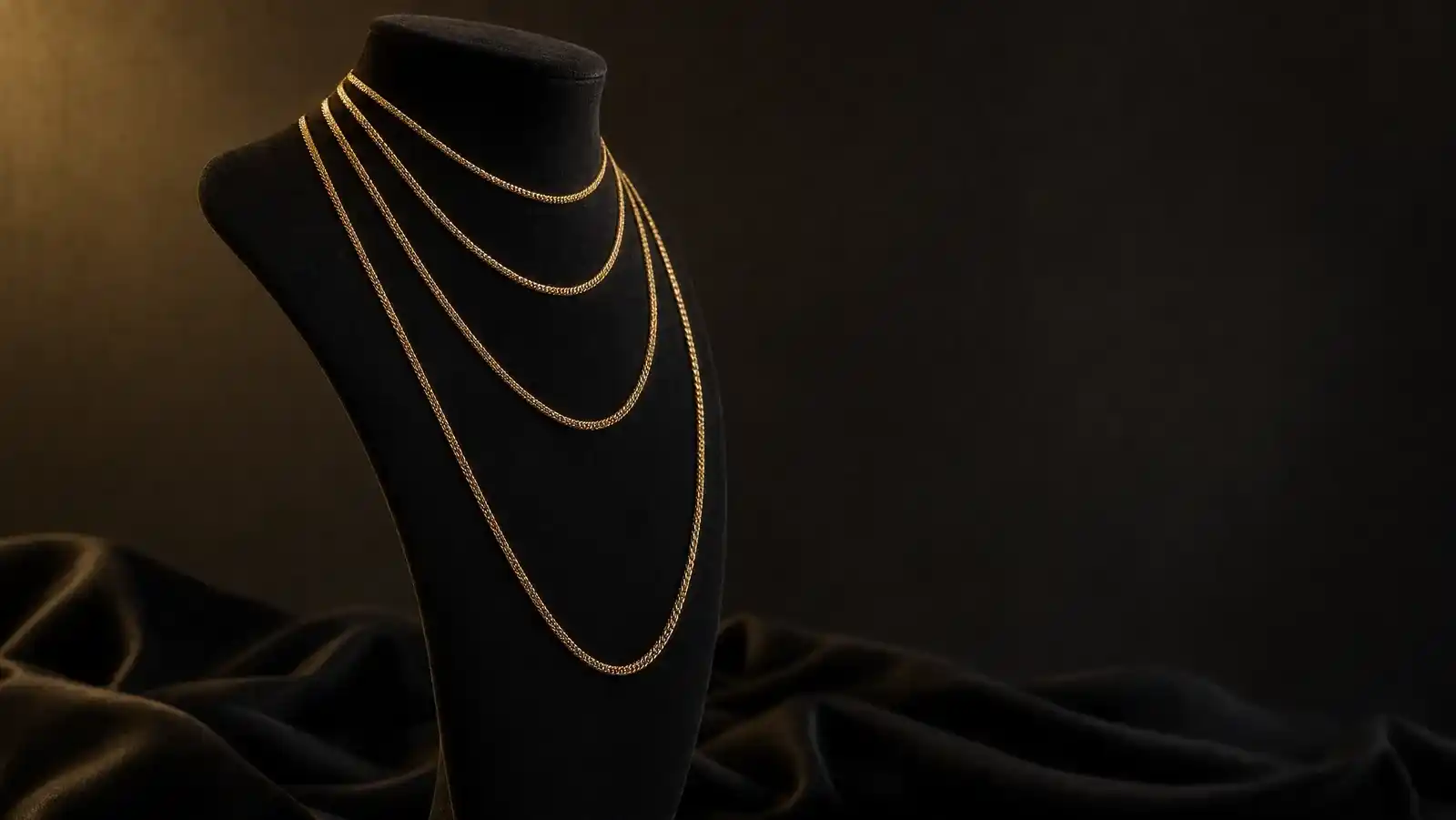
Many jewelers advise leaving at least two inches between strands so each reads as a distinct line — a 16-inch choker over an 18-inch princess over a 22-inch matinee is a common starting stack. Conventions vary widely, so treat any spacing rule as a starting point.
Practical notes on layering necklaces at different lengths: put the most delicate chain on top, and vary pendant weight rather than clustering heavy pieces at overlapping depths. Read our jewelry storage guide before you build a stack — layered chains tangle fastest.
Children's Necklaces: A Safety Note
We will not offer a sizing opinion here. The guidance from named authorities is unambiguous, and it is not about fit.
According to reporting in AAP News on a Food and Drug Administration warning, the American Academy of Pediatrics does not recommend that infants wear any jewelry, and the FDA has warned that teething necklaces and bracelets can lead to choking or strangulation, citing reports that included an 18-month-old strangled by an amber necklace during a nap. The AAP's stated reasoning is that suffocation is the leading cause of death for children under a year old.
For older children, the relevant standard is ASTM F2923, which the CPSC recognizes as industry best practice. According to compliance guidance from QIMA, it covers jewelry intended primarily for children 12 and under and requires that anything worn around the neck break apart under tension at a force of 15 pounds or more — a breakaway feature meant to prevent strangulation.
We would not improvise beyond that. Look for an explicit breakaway or safety clasp, check the age labeling, and treat anything for an infant as off the table.
When the Chain Is the Wrong Length
Three routes, in rough order of reversibility.
Return it. If the piece is unworn and within the return window, this is the cheapest and only fully reversible fix.
Add an extender. An extender is a short length of chain with a clasp at one end and a ring at the other, clipped between your clasp and the chain to buy one to three inches. It attaches without tools; the trade-off is a visible seam at the back and a second failure point.
Have it shortened. A jeweler removes links and reattaches the clasp. According to Dana Rebecca Designs, most jewelers charge under $50 for basic chain shortening and many finish the same day or within a few days; those figures are as of July 2026 and vary by market and chain complexity. That guide is blunt about the catch: once links are removed you cannot simply add them back, and extending later with new links often will not match. Treat it as permanent, and use a bench jeweler rather than pliers: the same guide warns that DIY cutting can damage a chain and lower its worth.
Choosing a Length in Five Minutes
Run it in order:
- Measure your neck at the base, then add 2 to 4 inches for the drop you want.
- Add your pendant's height, from the top of the bail to its lowest point.
- Check the neckline you will wear it with most, and give the piece clear space.
- Simulate the total with string in front of a mirror before you spend anything.
- Buy the inch figure, not the category name, and confirm it includes the clasp.
Land on 18 inches for a woman's chain or 20 for a man's and you are on the two most commonly cited defaults — also the safest choice for a gift when you cannot measure the recipient. Once length is settled, the remaining decision is construction, which is where the different necklace chain types come in.
FAQ
What is the most common necklace chain length?
Eighteen inches for women, twenty for men. Statement Collective lists 18 inches (46 cm) as princess length just below the collarbone and 20 inches (50 cm) as the men's everyday standard.
Does the clasp count in the measurement?
Yes. Goodstone's instructions specify laying the unclasped necklace flat and measuring from one end of the clasp to the other, including the clasp itself. If a chain measures short against its listing, check that you included it.
How much length does a pendant add?
It depends entirely on the pendant. Robinsons Jewelers gives the formula as pendant drop equals chain length plus pendant length, measured from the top of the bail to the lowest point, and declines to offer an average.
Can a jeweler make a chain longer instead of shorter?
Sometimes, by adding links, but a match is not guaranteed — Dana Rebecca Designs notes that added links often will not match perfectly. An extender is the reversible alternative for gaining an inch or two.
About the Author
Alfreda Borror
Alfreda Borror is the founding editor of Opulent Opal, writing research-based buying guides on diamonds, birthstones, and fine jewelry.