Flat Back vs Butterfly Back Earrings: Which Should You Wear?

This post may contain affiliate links. Read our affiliate policy
Flat back vs butterfly back earrings comes down to what sits behind your lobe. A flat back leaves a smooth disc lying against the skin, so nothing protrudes when you sleep or pull on headphones. A butterfly back leaves a sprung metal clutch that is cheaper, universal, and far faster to change. Neither wins outright.
Butterfly backs are the default for good reasons, and most of the internet's enthusiasm for flat backs skips past them. What follows is a head to head by axis, plus the two backs nobody compares properly: screw backs and the la pousette. For gauge, post length and disc sizing, start with our guide to flat back earrings.
What a Butterfly Back Actually Is
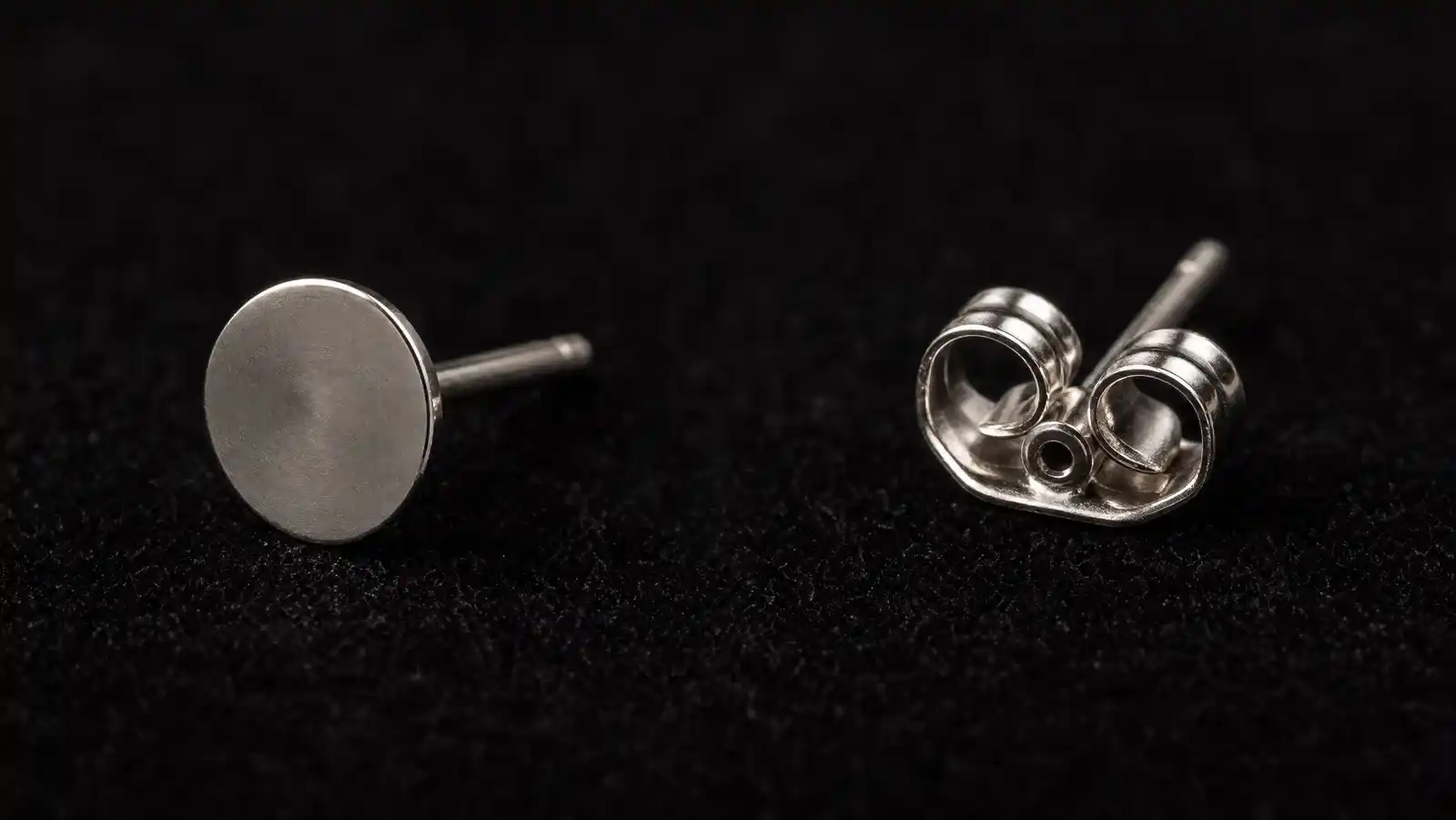
A butterfly back, also sold as a friction back, push back or clutch, is two sprung loops of sheet metal pressed into a small tube. The post is soldered to the front of the earring, passes through the ear from front to back, and the clutch grips the post by friction alone. Some posts are notched with a shallow groove so the clutch has something to seat into.
That is the whole mechanism. It has three consequences worth naming.
- It is universal. Any clutch fits any post of roughly the same gauge, which is why a jar of spare butterflies costs almost nothing.
- It grips by friction, and friction fades. The loops splay with repeated removal, and a splayed clutch rests on the post rather than gripping it.
- It sticks out. The clutch is a three dimensional object sitting between your lobe and whatever you press your ear against.
Worth saying plainly: the butterfly-back listings we read rarely publish a post gauge, a post length or a clutch material. You are buying an unspecified part, which is also why replacements are so cheap.
What a Flat Back Actually Is
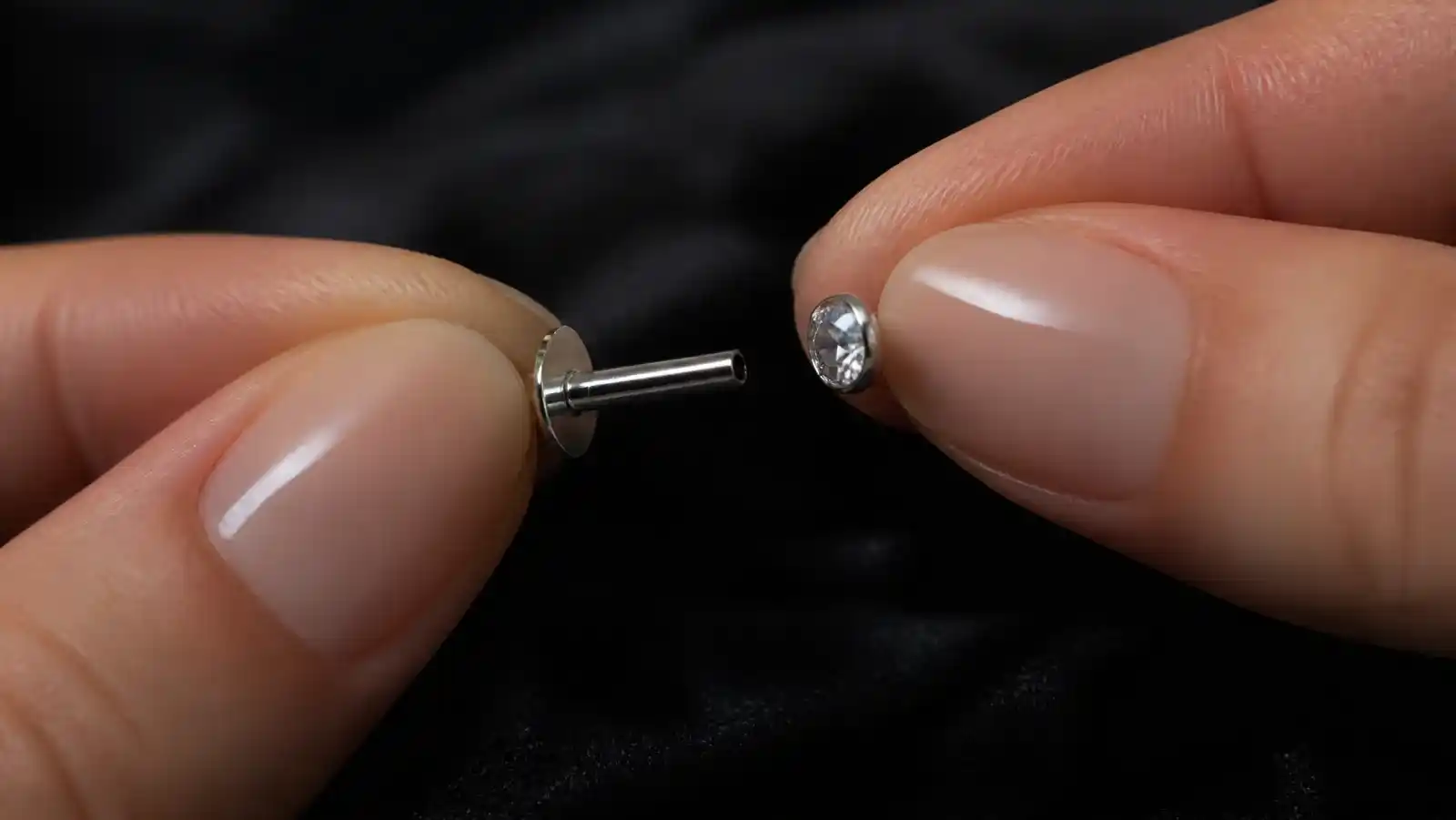
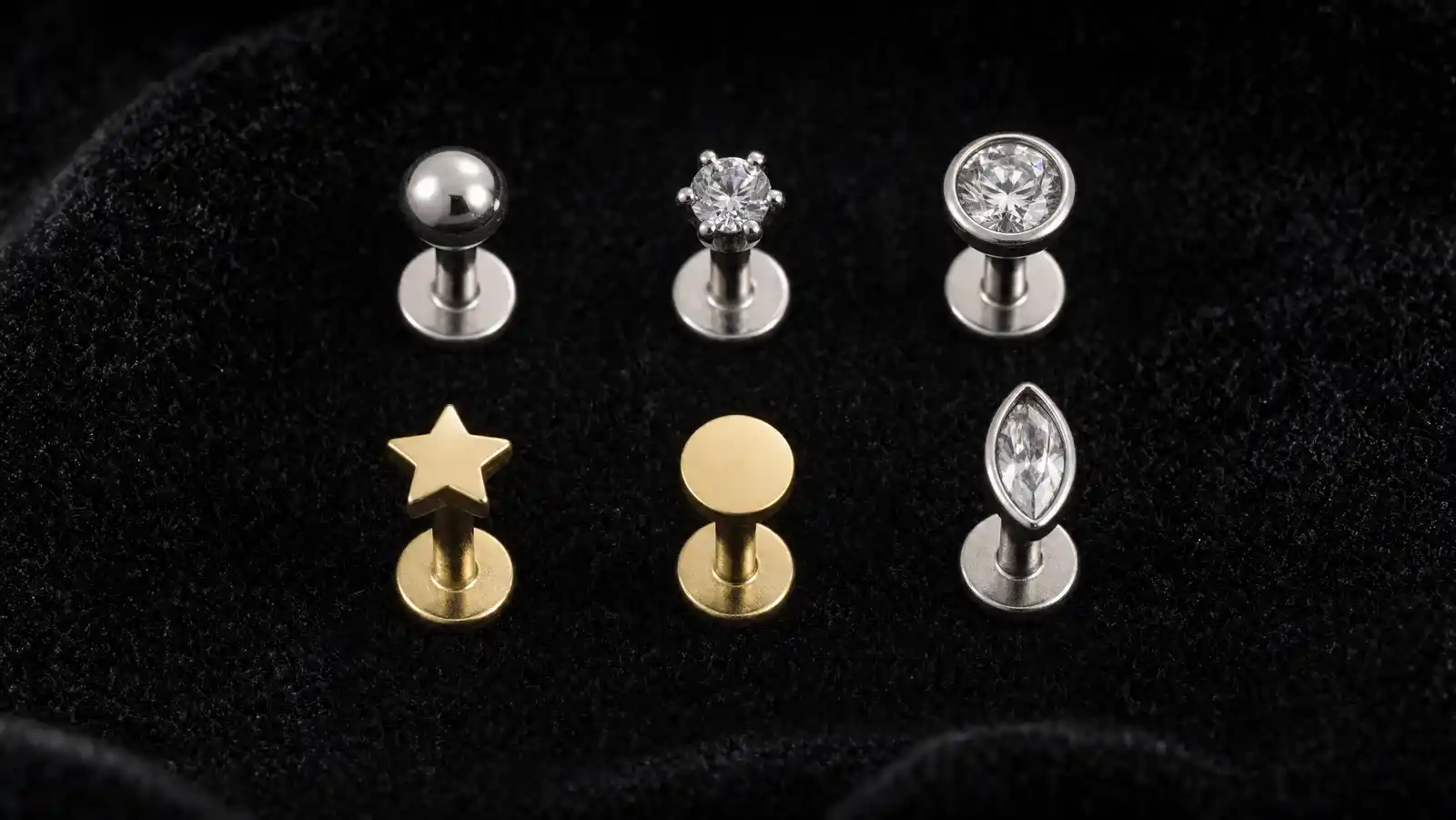
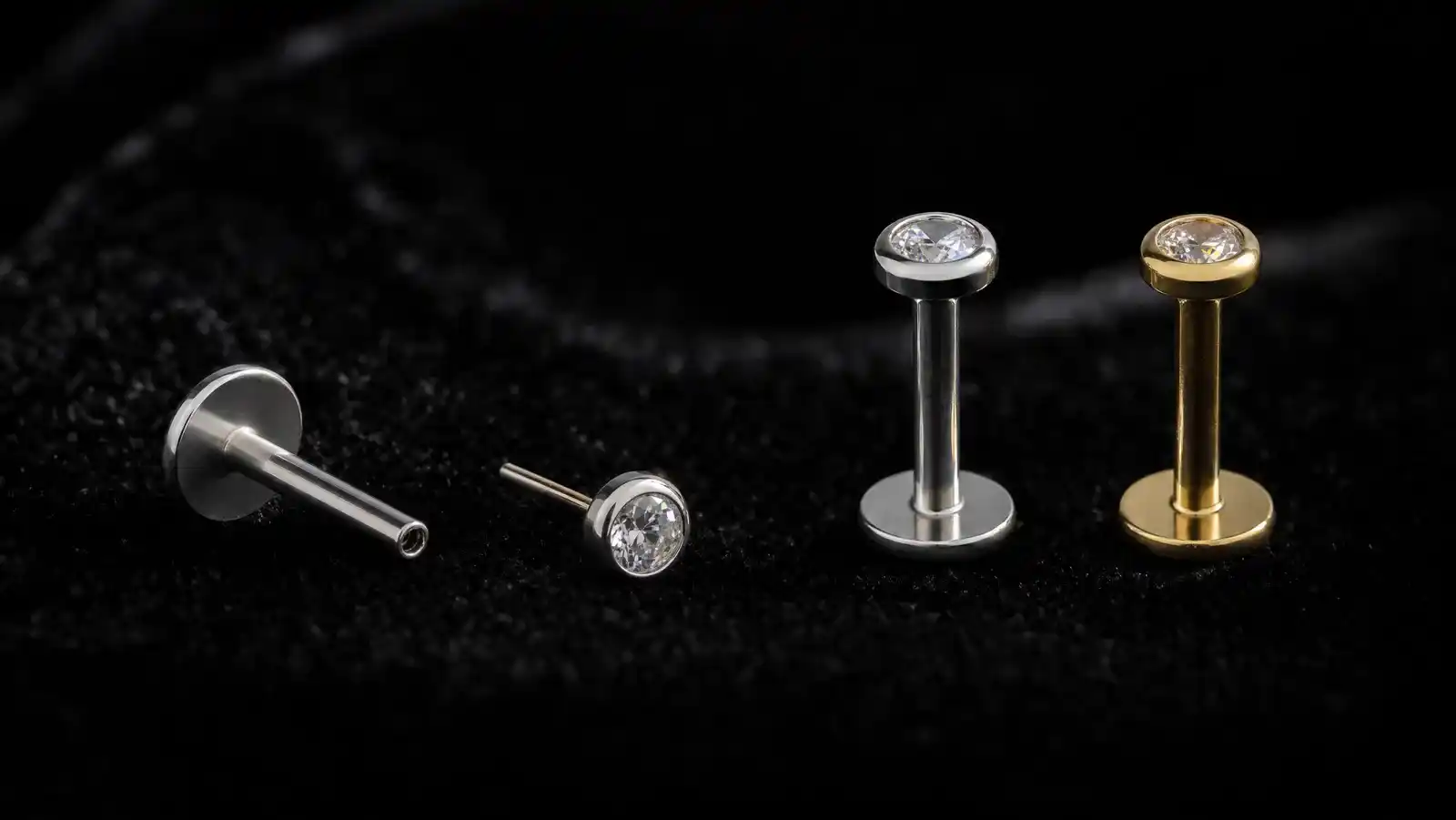
A flat back is a labret post. The post is a straight bar with a flat disc fixed permanently at one end. It loads from behind the ear, the disc stays behind the lobe, and the decorative front attaches at the front of the post once it is through.
The front attaches one of two ways. On a threadless post, a slightly bent pin on the decorative end is pushed into a hollow post and held by its own tension. On an internally threaded post, the end screws into a tapped hole. The distinction between threadless and threaded posts matters enough that it deserves its own explanation, and it is the single most common reason a flat back you bought does not fit a front you already own.
The Association of Professional Piercers is explicit about how that join should be built. Its jewelry standards for initial piercings require that "all threaded or press-fit jewelry must have internal tapping (no threads on exterior of posts and barbells)," and that "metals must have a consistent mirror finish on surfaces that frequently come in contact with tissue." In other words, threads on the outside of a post, the cheap way to make the part, are ruled out by the standard the industry uses.
Flat Back vs Butterfly Back Earrings, Axis by Axis
| Axis | Flat back | Butterfly back |
|---|---|---|
| Profile behind the ear | Flush disc | Protruding sprung clutch |
| Sleeping and headphones | Better | Worse |
| Main failure mode | Front end loosens or pops off | Clutch slides off the post |
| Speed of changing | Slow, two hands, often a mirror | Seconds |
| Cost per pair | Higher | Lowest in the category |
| Replacing the lost part | Must match gauge, length and system | Any clutch, pennies |
| Fit knowledge required | Gauge, post length, disc diameter | Effectively none |
| Typical materials | Implant-grade titanium, solid gold | Anything, often unstated |
| Used for fresh piercings | Studio standard | Uncommon |
| Practical in cartilage | Yes | Rarely |
Comfort Is the Axis Flat Backs Win Outright
This is the honest case for flat backs, and it is narrow but real. A disc lying flat against the back of the lobe has nothing to press into skin. A butterfly clutch does, and it is worst in exactly the situations people describe most: sleeping on one side, over-ear headphones, a pillow, a phone held against the ear, a helmet.
Flat backs also cannot snag. A butterfly clutch is an open sprung shape that catches hair, scarves and sweater necklines, and every snag can pull the clutch off without you noticing.
The trade is that you give up speed. Loading a labret post from behind the ear, then locating the front end on a post you cannot see, is a genuinely fiddly two-handed job the first several times. It is enough of a skill that "how to put in flat back earrings" is a search in its own right.
Security: Do Flat Backs Fall Out?
They can, but they fail differently, and the difference matters more than the raw rate.
A butterfly back fails backwards. The clutch slides off, the post follows, and the earring is gone. You usually discover it hours later.
A flat back fails forwards. The disc cannot pass through the piercing, so the post rarely goes anywhere. What comes off is the decorative front: a threadless pin loses tension, or a threaded end backs out over a week of small movements. You lose the pretty part and keep the post in your ear.
There is a real asymmetry in what that costs you. Losing a butterfly clutch is a one dollar problem solved from a jar. Losing a threadless end or a labret post means matching gauge, post length and attachment system before you can wear the earring again, and mismatched parts are the most common reason a replacement does not work.
Neither back is a lock. If you want a closure whose job is specifically not coming off, that is the argument for screw backs and la pousettes below.
Cost, Replacement and the Fiddle Factor
Butterfly backs are among the cheapest working closures in jewelry, and that is not a small point. A universal part that costs almost nothing and fits almost anything is a genuine engineering win.
Flat backs cost more for three compounding reasons: the post is machined rather than a plain wire, the material is usually a specified alloy rather than an unnamed one, and the front is a separate manufactured component. You are also buying into a system, because ends and posts have to match.
Whichever you wear, the maintenance argument is the same one we make everywhere: closures fail because they are dirty and worn, not because they are cursed. Our earring care and cleaning guide covers the part most people skip.
Materials: Why Flat Backs Skew Titanium
This is where the two categories genuinely diverge, because flat backs came out of the piercing trade and inherited its material standards.
The Association of Professional Piercers recommends, for initial piercings, metals meeting ASTM or ISO standards for surgical implants. Specifically, it names "implant certified titanium (Ti6Al4V ELI) that is ASTM F-136 compliant, ASTM F1295, ISO 5832-3 compliant, or commercially pure titanium that is ASTM F-67 compliant," and for steel, material that is "ASTM F-138 compliant or ISO 5832-1 compliant."
Those two titanium standards are different materials, and listings blur them constantly.
- ASTM F136 is the specification for wrought Ti-6Al-4V ELI, a titanium alloy containing roughly 6 percent aluminium and 4 percent vanadium, with ELI meaning extra low interstitial content. Titanium mill suppliers list Grade 23, often written G23, as the designation for that same ELI alloy, so a listing claiming both F136 and G23 is being consistent, not contradictory.
- ASTM F67 covers unalloyed titanium for surgical implant applications in four grades, designated UNS R50250, R50400, R50550 and R50700 by the standard. That is commercially pure titanium, a different material from F136.
Steel is not the villain it is sold as, but it is nickel-bearing by design. Per published mill composition ranges, SAE 316L runs about 16 to 18 percent chromium, 10 to 14 percent nickel and 2 to 3 percent molybdenum, while 316LVM, the vacuum-melted version supplied to ASTM F138, runs about 17 to 19 percent chromium and 13 to 15 percent nickel. The nickel is bound in the alloy rather than sitting loose on the surface, which is part of why the APP lists implant-grade steel as an acceptable material rather than ruling it out.
What regulators care about is release, not content. The EU Nickel Directive, now carried in REACH Annex XVII entry 27, sets a limit of 0.2 micrograms per square centimetre per week for post assemblies inserted into pierced ears and other pierced parts of the body, against 0.5 for items in prolonged contact with intact skin, measured by the EN 1811 test method. The stricter number for pierced tissue is the whole point.
Sensitivity is common enough to plan around rather than dismiss. European literature on nickel allergy puts prevalence at roughly 8 to 19 percent of adults, and Larsson-Stymne and Widstrom, surveying 960 schoolgirls in Contact Dermatitis in 1985, reported nickel allergy in 13 percent of those with pierced ears against 1 percent of those without. We are not diagnosing anyone. We are saying that the material question is not paranoia, and that a piercer may advise a specific material for a specific ear.
If titanium is where you are landing, the titanium flat backs we recommend goes listing by listing on what each seller actually proves versus what it merely asserts. For the wider metal question across all earring styles, see our hypoallergenic earrings guide.
Fresh Piercings, Healed Piercings and Cartilage
Flat backs are the studio standard for new piercings, and the reason is structural rather than cosmetic: the APP's standards ask for smooth, mirror-finished surfaces with no external threads on anything that passes through tissue, and a labret post with an internally threaded or press-fit end is built to that description. A butterfly clutch, an open sprung part with edges, is not.
For a healed lobe the argument softens considerably. A healed lobe can generally take either back, and butterfly backs are perfectly reasonable there.
Cartilage is where flat backs stop being a preference and start being the practical answer. Helix, conch, flat and tragus placements sit against the side of the head or inside the ear's folds, and there is often nowhere for a butterfly clutch to sit without pressing on something. The disc lies flat where a clutch would not fit.
Anything about healing timelines, irritation or whether a specific piercing is ready for a jewelry change belongs with the piercer who did it, not with us.
Screw Backs and La Pousette: The Other Two Answers
The comparison is usually framed as a two-way choice, which leaves out the two backs that exist specifically to not come off.
Screw back earrings use a threaded post and a clutch that screws down. Security is genuinely higher than friction, and the failure modes are different in kind: threads can strip or cross-thread, and a cross-threaded clutch feels tight while holding nothing. They are also slow, which is a feature for studs you rarely remove and a nuisance for anything you change daily. Note that a screw-back post is externally threaded, which is the construction the APP's initial-piercing standard rules out for jewelry passing through tissue, so screw backs are a healed-lobe closure rather than a fresh-piercing one.
La pousette backs are the high end of the friction-replacement category. According to Mozeris Fine Antiques, which dates antique earrings by their fastenings, the la pousette is a patented locking back released by pressing two small tabs, and because it costs more to fit, it tends to appear on earrings that were expensive when new. The practical catch is that push-tab lookalike clutches are sold widely, so a cheap back with two tabs may not be the same part.
Who Should Pick Which
- You sleep on your side, wear headphones for hours, or work out in your earrings. Flat back. This is the scenario the format was made for.
- You have cartilage piercings. Flat back, in almost every case.
- You change earrings daily and own a lot of pairs. Butterfly. The seconds add up, and the universal clutch means nothing is orphaned.
- You are wearing serious stones and want the lowest chance of loss. Screw backs or a la pousette, not a friction clutch.
- You buy earrings without checking specifications. Butterfly, honestly. Flat backs require you to know your gauge, your post length and your attachment system, and buying the wrong one is the most common disappointment in the category.
- You want one pair to live in your lobes for months. Flat back, in a material named on the listing rather than described as surgical or hypoallergenic without a standard.
FAQ
Are flat back earrings better than butterfly backs?
Better at comfort, cartilage and staying put in the ear. Worse at cost, speed of changing and ease of replacement. For a healed lobe you change daily, butterfly backs are the rational choice.
Do flat backs fall out?
The post itself rarely does, because the disc cannot pass through the piercing. What comes off is the front: a threadless pin that has lost tension, or a threaded end that has unscrewed. Threadless ends need the pin's slight bend intact to hold.
Can I put a flat back post through an existing butterfly-back piercing?
Usually, if the gauge matches. Standard pierced-ear posts and many flat backs are close in diameter, but flat backs are sold by gauge and post length while butterfly studs typically publish neither, so the match is not guaranteed.
Why do my butterfly backs keep loosening?
The clutch grips by friction from two sprung loops, and those loops splay with repeated removal. A clutch that slides on without resistance has stopped gripping, and replacements cost very little.
Is surgical steel the same as implant-grade steel?
No. "Surgical steel" is a marketing phrase with no fixed definition. The APP names a specific standard instead, steel that is ASTM F-138 or ISO 5832-1 compliant, which is a claim a seller can either document or not.
The Bottom Line
Flat back vs butterfly back earrings is not a quality contest. It is a match between a closure and a life. Flat backs buy comfort and a flush profile at the cost of money, fiddliness and the requirement that you know your own measurements. Butterfly backs buy speed and disposability at the cost of a lump behind your ear and a clutch that will eventually let go.
If you are moving toward flat backs, the specification work is the whole job: gauge, post length, disc diameter and whether the ends are threadless or threaded. That is what our complete guide to flat back earrings exists to sort out before you spend anything.
About the Author
Alfreda Borror
Alfreda Borror is the founding editor of Opulent Opal, writing research-based buying guides on diamonds, birthstones, and fine jewelry.