Flat Back Earrings: A Complete Guide to Fit, Materials and Sizing

This post may contain affiliate links. Read our affiliate policy
Flat back earrings are studs that close with a flat disc behind the lobe instead of a butterfly clutch. The post is loaded from behind, the decorative end attaches at the front, and the smooth disc lies flush against the back of the ear. That single change fixes most of what people dislike about ordinary studs: the back that slips off, the clutch that digs in on a pillow, the post that is always slightly crooked.
The category has its own vocabulary, and the vocabulary is where shoppers get lost. Labret, flatback, push pin, threadless, internally threaded, 18G, 6mm, 3mm disc. None of it is decorative language. Each term maps to a physical dimension or a mechanism, and getting one of them wrong is the difference between an earring you forget you are wearing and one you take out by Thursday.
This guide covers the whole territory at working depth: what these earrings are, the material standards that actually mean something, how the post systems differ, and how to read a sizing spec without guessing. It is the hub of a series, so where a subject deserves its own article we point you forward rather than padding this one.
What Is a Flat Back Earring, Exactly?
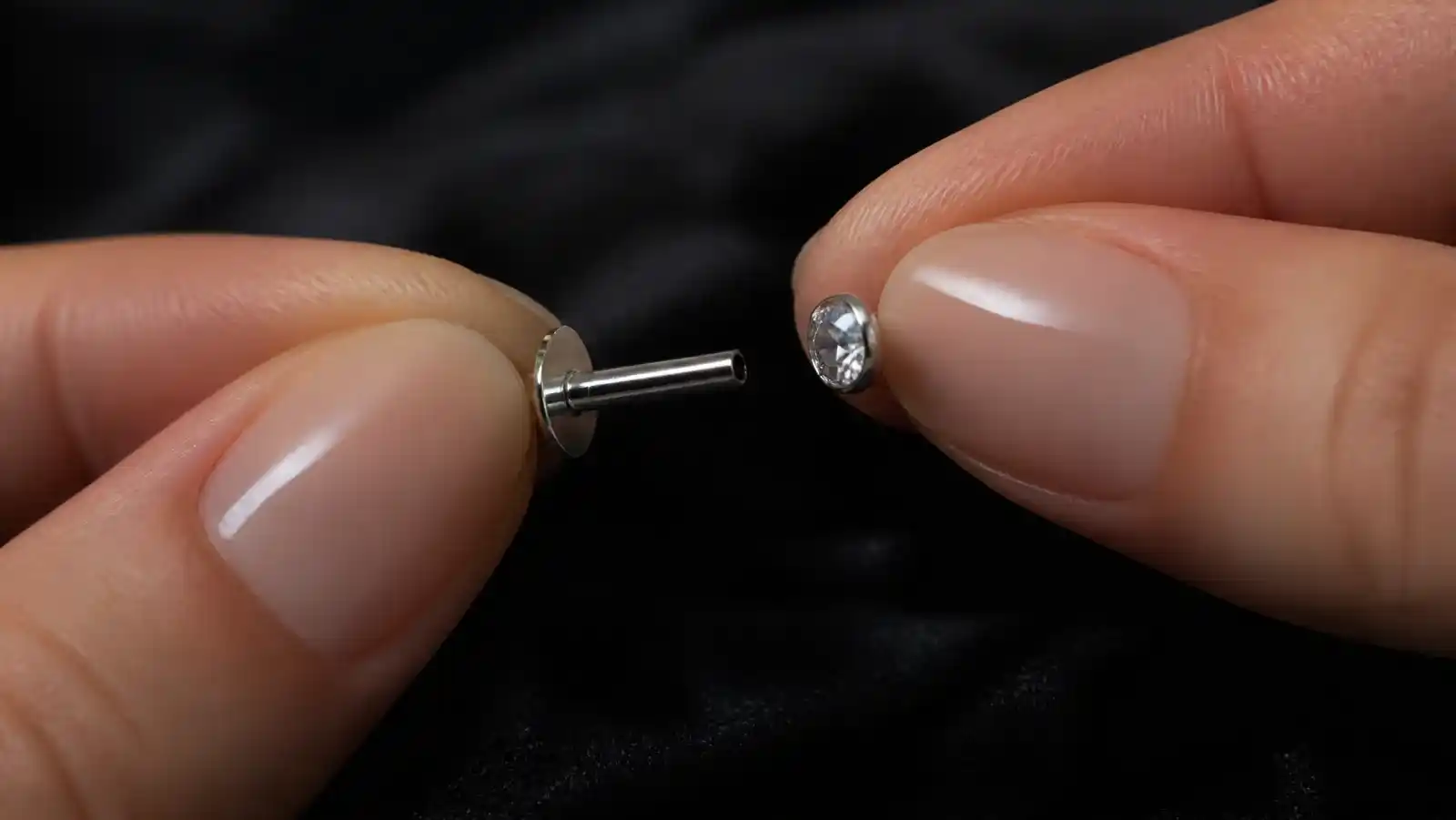
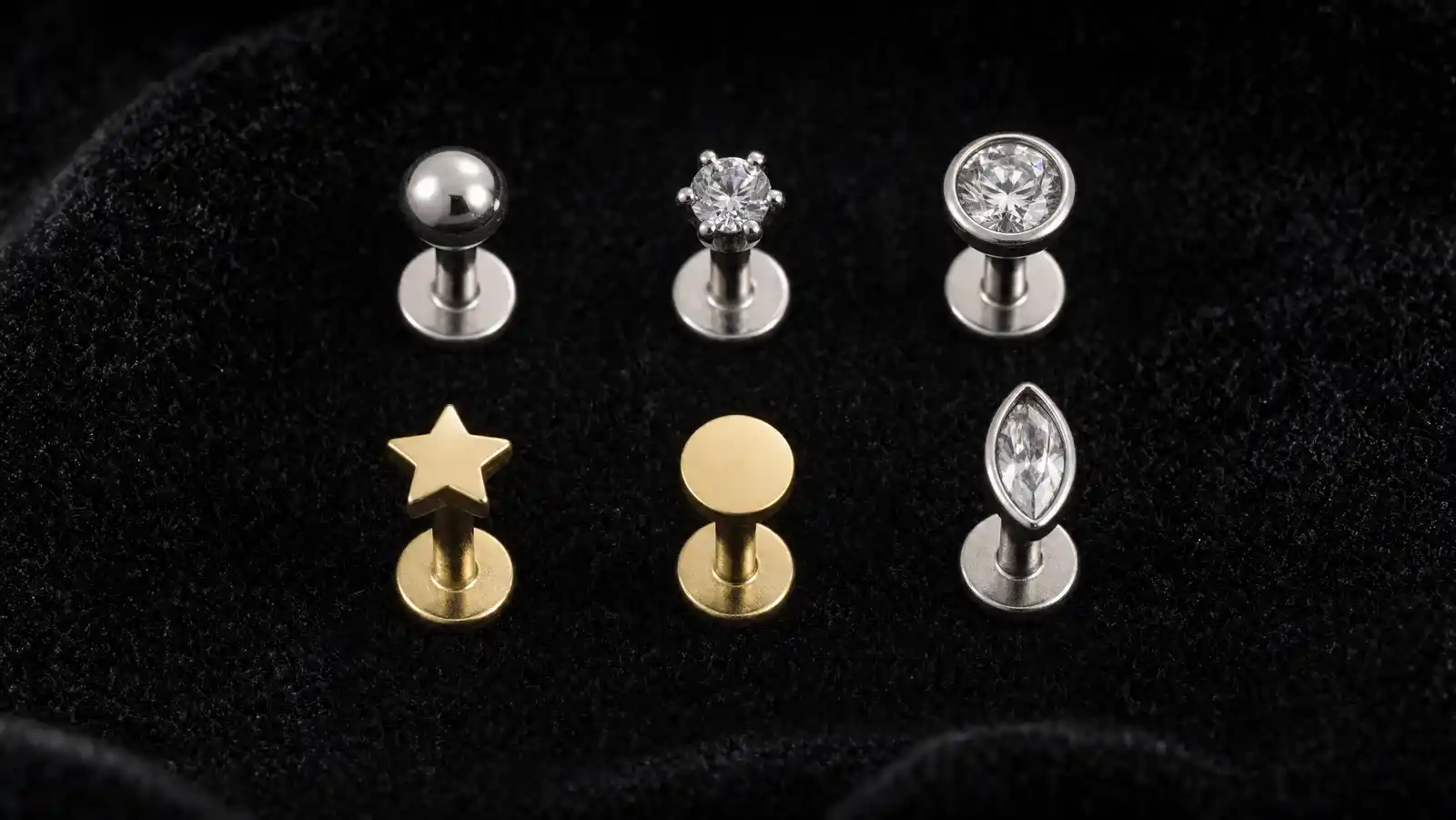
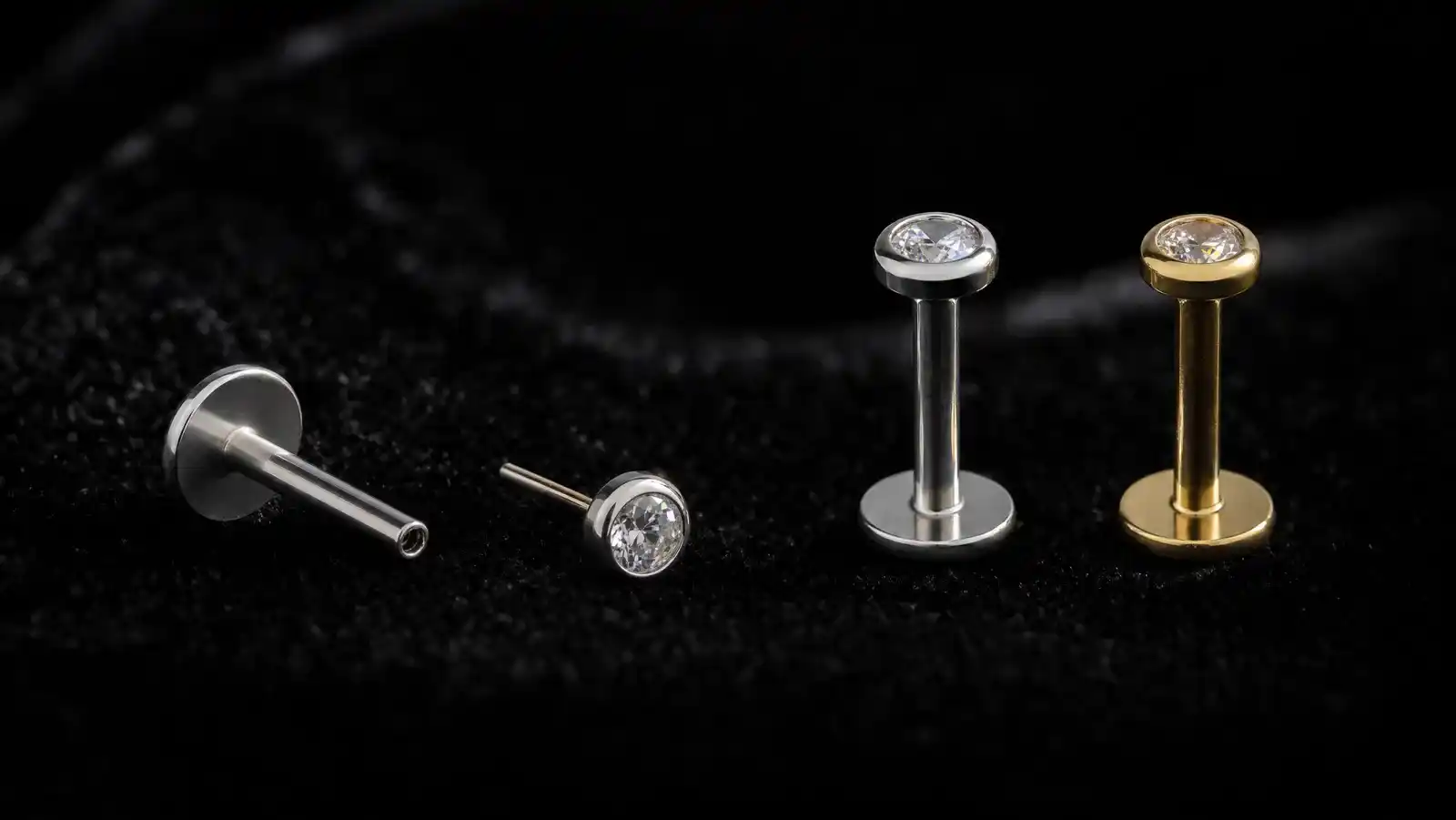
A flat back earring has three parts in most designs: a post (also called the bar, the labret or the shaft), a flat disc that forms the back, and a decorative end that sits at the front of the ear. The disc and post are usually a single machined piece. The end is removable so you can swap styles on the same post.
The name comes from body piercing, not from fine jewelry. In piercing catalogs the same part is called a labret, because the flat disc was designed to sit comfortably against the inside of a lip piercing. The design migrated to lobes and cartilage for the same reason it worked there: a flat plate spreads pressure across a wider area than a pinching clutch does.
You will see three trade names for essentially the same object:
- Flat back or flatback: the general retail term, describing the back of the piece.
- Labret: the piercing industry term, describing the post and disc together.
- Push pin or press fit: a term for the threadless version specifically, where the decorative end is a bent pin that presses into a hollow post.
The important consequence is that flat back earrings are sold as systems, not as single objects. A post from one maker and an end from another may not fit, because gauge, pin diameter and threading conventions differ. We read a lot of listings that quietly assume you already know this. Very few say it outright.
If you are new to earring terminology in general, our general guide to buying earrings sets out the vocabulary for the wider category.
Flat Backs vs Butterfly Backs
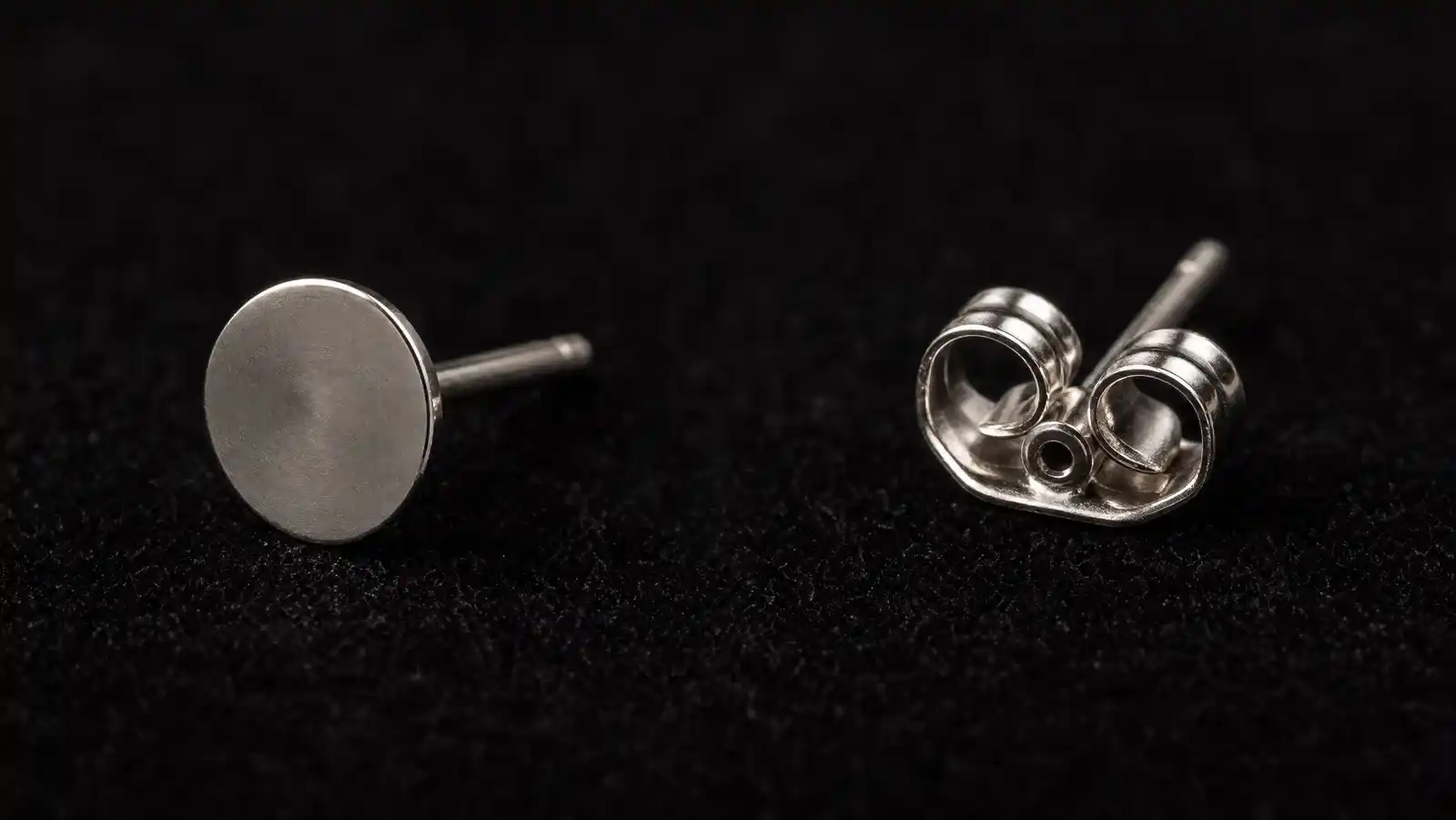
A butterfly back, sometimes called a friction back or a scroll, is the folded wire clutch that ships with most mass market studs. It grips the post by friction between two sprung loops. It is cheap to make, it fits almost any post, and it is a common reason earrings go missing.
The differences that matter day to day are these:
- Loading direction. A butterfly stud goes in front to back. A flat back goes back to front, because the disc end is fixed and the decorative end is the part that attaches.
- Pressure distribution. The disc is a broad, smooth plate. A butterfly clutch is two narrow wire loops, which is why it prints a shape into the back of the lobe after a few hours.
- Retention. Friction clutches loosen as the sprung loops fatigue. Threadless and threaded flat backs hold by mechanical fit, not by spring tension alone.
- Sleep and hair. Butterfly clutches catch on hair and pillowcases. A flat disc has no exposed edges to catch.
- Hygiene. Butterfly clutches have folded seams that trap debris. A flat disc is one smooth surface, which makes routine cleaning simpler.
There is a genuine trade-off, and it is worth stating plainly rather than selling around. Butterfly studs are cheaper, universal in fit, and easy to replace when a back goes missing. Flat back systems cost more per piece, lock you into one maker's fitting, and are fiddlier to insert the first few times. For a single pair of occasional dress earrings, a butterfly clutch is not a problem. For something you wear continuously, the flat back wins on comfort and on staying put.
One more point the marketing rarely makes: the Association of Professional Piercers notes that jewelry which is too thin in gauge can contribute to migration or rejection of a piercing. Butterfly studs are typically sold without any published gauge at all, while flat back systems almost always state one. That transparency is itself a reason the category is taken more seriously. A full breakdown of how flat backs compare with butterfly backs goes further into the mechanics, the costs and the edge cases than we will here.
The Material Standards That Actually Matter
This is the part of the category where the word "hypoallergenic" is doing the most work and carrying the least meaning. Hypoallergenic is not a regulated term. A standard number is. When a listing names a standard, you can look up what that standard requires. When it says "surgical grade" with no number, you cannot.
It is also the section that matters most if you have sensitive ears, because the standard a post is built to is the only part of the claim you can check yourself.
Here is what the numbers mean.
ASTM F136 titanium, also called Grade 23
ASTM F136 covers the alloy Ti-6Al-4V ELI, titanium alloyed with roughly six percent aluminum and four percent vanadium. ELI stands for extra low interstitial, meaning tighter caps on the dissolved gases and iron that make titanium brittle. According to the Wikipedia reference entry on body jewelry materials, this same alloy is designated Grade 23, which is why you see "G23" stamped on packaging and used in listing titles. Suppliers that publish the F136 chemistry, such as the wholesaler Metal Mafia, state that the ELI designation holds oxygen below 0.13 percent and iron below 0.25 percent.
The Association of Professional Piercers recommends, for initial piercings, "implant certified titanium (Ti6Al4V ELI) that is ASTM F-136 compliant, ASTM F1295, ISO 5832-3 compliant, or commercially pure titanium that is ASTM F-67 compliant." That sentence is the reason F136 dominates this category.
ASTM F67 titanium, commercially pure
ASTM's own listing describes F67 as the standard specification for unalloyed titanium for surgical implant applications, covering four grades: Grade 1 (UNS R50250), Grade 2 (UNS R50400), Grade 3 (UNS R50550) and Grade 4 (UNS R50700). The grades are separated by their oxygen and iron limits, with Grade 4 carrying the most oxygen and the highest strength. Commercially pure titanium contains no aluminum or vanadium at all, which is why some wearers and some piercers prefer it, and it is explicitly on the APP's accepted list alongside F136.
316L stainless steel and ASTM F138
316L is the steel most "surgical steel" earrings are made from. It is not nickel-free. Reference summaries of the alloy, including Wikipedia's entry on surgical stainless steel, put typical SAE 316L composition at 16 to 18 percent chromium, 10 to 14 percent nickel and 2 to 3 percent molybdenum, with the balance iron. The implant-grade version of that steel is specified by ASTM F138, and the APP accepts steel for initial piercings when it is "ASTM F-138 compliant or ISO 5832-1 compliant; ISO 10993-(6,10, or 11) compliant; or (EEC [European] Nickel Directive compliant."
The distinction that matters is between nickel content and nickel release. A passivated, well-finished 316L piece can lock its nickel into the alloy and release very little. A poorly finished one can release enough to provoke a reaction in a sensitized wearer. Content alone does not tell you which you have.
The EU Nickel Directive and REACH
This is where a number replaces a marketing claim. Directive 94/27/EC, adopted in 1994 and known as the Nickel Directive, set migration limits rather than composition limits. Per Wikipedia's summary of the directive, the limits are 0.2 micrograms per square centimeter per week for post assemblies inserted into pierced ears and other pierced parts of the body, and 0.5 micrograms per square centimeter per week for other items intended for direct and prolonged skin contact. Compliance is measured by EN 1811, which soaks the object in artificial sweat for a week and then measures the nickel released. Since 1 June 2009 the directive has been subsumed into the REACH Regulation as item 27 of Annex XVII.
Note how strict the piercing limit is: less than half the allowance for a bracelet or a watch case. That asymmetry exists because a post sits inside a wound channel, not on intact skin.
Niobium and gold
Niobium is the quiet alternative. The body jewelry materials reference describes pure niobium as inert, unreactive to body fluids, and usable as a hypoallergenic alternative to nickel, and it anodizes to color the way titanium does. Its drawback is that it carries no implant-grade designation, so there is no standard number to check.
For gold, the APP's position is specific: 14 karat or higher, nickel-free and cadmium-free, alloyed for biocompatibility, with plated and gold-filled pieces unacceptable and gold above 18 karat too soft to hold up. If you want the wider comparison, our overview of the metals used across earrings sets solid gold, platinum, silver and steel side by side.
Titanium Flat Backs Worth Buying
We do not wear-test jewelry. What we do is read the specification a seller publishes and check it against itself, and in this category that exercise is unusually productive.
When we shortlist the titanium flat backs we recommend, four filters do most of the work.
One: the listing names a standard, not an adjective. "ASTM F136" or "ASTM F67" is checkable. "Implant grade" on its own, "surgical grade", "titanium alloy" and "hypoallergenic" are not. A seller who knows which standard the bar meets will say so, because it is the strongest thing they can say.
Two: the specification agrees with itself. The most common failure we see is a title that says one gauge and a bullet list that says another, or a title reading 18G with a size chart offering only 16G. When the title and the specification table disagree, the listing is not describing a real part, and there is no way to know which number ships. Say it plainly and move on.
Three: the numbers you need are actually published. A complete flat back listing states gauge, wearable post length, disc diameter and the end fitting. Listings routinely publish the first and skip the rest. Absence of a spec is information. If a seller does not publish a post length, they are asking you to buy a dimension sight unseen.
Four: the fitting system is named. Threadless, internally threaded and externally threaded ends are not interchangeable. A listing that shows a photo of a pin and never uses the word threadless is leaving you to infer the mechanism from a product image.
Two further points worth weighing. Anodized color on titanium is an oxide layer, not a plating: the body jewelry materials reference describes titanium as able to be anodized to create a layer of colored oxide on the surface, which is why anodized color does not chip or peel the way plating does, though suppliers note that heavy abrasion can still alter it. And on finish: the APP states that "metal body jewelry should be polished to a smooth, mirror finish," which is a property you can partly assess from a close macro photograph and cannot assess at all from a rendered image. When a listing is honest about all of this, credit it. Plenty are.
Putting Them In and Taking Them Out
The learning curve is real and it is short. The reason flat backs feel hard at first is that they reverse the direction you have used your whole life.
The sequence, in brief:
- Separate the post from the end. Threadless ends pull straight out. Threaded ends unscrew.
- Load the post from behind the ear. The flat disc stays at the back; the bare post comes through to the front.
- Hold the disc steady with one hand, pinched between finger and thumb, so the post does not retreat.
- Attach the end at the front. A threadless pin gets pushed straight in with a small amount of pressure. A threaded end screws on, clockwise, until it is just firm.
- Check the fit by gently tugging the front end. It should not move.
Two habits help. Work over a towel or a closed drawer, because ends are small and floors are unforgiving. And do it in front of a mirror the first several times rather than by feel, since flat backs give less tactile feedback than a butterfly clutch.
A common and avoidable mistake is over-tightening a threaded end. The threads on body jewelry are fine and the parts are small; hand-firm is the target, and torque adds nothing. Another is pushing a threadless pin only halfway, which is exactly how ends come off in a sweater.
Keeping the parts clean matters more here than with a butterfly clutch, since the hollow post of a threadless system has an interior. Our cleaning and storage guide covers routine care for the jewelry itself. For anything to do with a healing piercing or with skin that is reacting, a piercer or a clinician is the right person to ask, not a buying guide. A step-by-step walkthrough of how to put in flat back earrings deserves the full treatment, so read this as the short version.
Threadless, Internally and Externally Threaded Posts
Three fitting systems dominate, and the choice affects comfort more than the metal does.
Threadless, also called press fit or push pin. The post is a hollow tube. The decorative end has a solid pin that has been given a slight bend. Per Bodyartforms and other suppliers who explain the mechanism, when you press the bent pin into the straight tube the pin tries to spring back to its original shape, and that spring force pushes it against the inner wall of the tube, holding by friction. You adjust retention by adjusting the bend: a little more bend holds harder, a little less makes the end easier to remove.
Internally threaded. The post is hollow and tapped with a thread on the inside. The decorative end carries a small male thread that screws into it. The APP's stated advantage is exactly what it sounds like: with internal threading, "the part of the jewelry that passes through your skin is smooth, and the threads are on the removable end(s)."
Externally threaded. The thread is cut onto the outside of the post itself, and the end is tapped to receive it. This is the cheapest of the three to manufacture, and it means a threaded surface travels through the piercing channel every time you change the jewelry.
A short comparison:
| System | Post surface through the ear | Changing ends | Notes |
|---|---|---|---|
| Threadless | Smooth tube | Fastest, no rotation | Retention depends on the pin bend |
| Internally threaded | Smooth | Screw on, screw off | Small threads, easy to cross-thread |
| Externally threaded | Threaded | Screw on, screw off | Threads pass through the channel |
For practical purposes: threadless is the easiest to live with and the easiest to lose if the pin is under-bent. Internally threaded is the most secure for anything heavy or dangly. Externally threaded is the one to ask questions about before buying. A deeper look at the difference between threadless and threaded posts, including which ends cross-fit between makers, belongs in its own article.
Gauge, Post Length and Disc Size
Three numbers decide whether a flat back earring fits you. All three are published by good sellers and skipped by bad ones.
Gauge, which is thickness
Gauge measures the diameter of the post, and it runs backwards: a higher number is thinner. Body jewelry size charts from retailers such as BodyCandy and bodyjewelry.com give the standard conversions:
| Gauge | Millimeters |
|---|---|
| 20G | 0.8 mm |
| 18G | 1.0 mm |
| 16G | 1.2 mm |
| 14G | 1.6 mm |
Standard pierced lobes are commonly 20G or 18G. Those same size guides note that 16G (1.2 mm) and 14G (1.6 mm) are the most common labret sizes, and 16G is the size most often used for cartilage placements. You cannot put a 16G post through an 18G hole without stretching it, so the gauge you buy has to match the piercing you have, not the one a chart suggests.
Post length, which is the part that matters most
Post length is the wearable length: measured, as the sizing guides describe it, from the base of the flat disc to the top of the post where the end attaches. It is not the overall length of the piece with the decoration on.
Published ranges for flat back shafts run roughly 6 mm to 12 mm. Sellers often list in inches, which introduces its own confusion: 5/16 inch is described as 8 mm, and 3/8 inch is variously listed as 9.5 mm or rounded up to 10 mm by different sellers. When a listing gives you inches only, convert before you buy, and when two sellers give different millimeter values for the same fraction, assume the tolerance is real.
Length is where fit problems live. Too short and the disc can press into tissue. Too long and the post moves, the end sits proud of the ear and catches on things. A piercer may advise a longer post initially and a shorter one later, a process piercers call downsizing, but the timing of that is a conversation to have with the person who did the piercing.
Disc diameter
Disc diameter is the width of the flat plate at the back. Supplier listings and size guides commonly offer 2.5 mm, 3 mm, 4 mm and 5 mm discs, with 3 mm and 4 mm the sizes most often stocked for lobe and cartilage jewelry. A wider disc spreads pressure and is less likely to press in; a narrower one is less visible and less likely to sit against an adjacent piercing. This is the spec most often omitted entirely.
A full chart with earring gauge sizes explained in both millimeters and inches, plus conversion tables, is worth keeping separately from an article this long.
Planning a Curated Ear
A curated ear is a deliberate arrangement of several piercings styled as one composition rather than as a set of matching pairs. Flat backs are the workhorse of the format for a mechanical reason: with no butterfly clutches in the way, pieces can sit close together without their backs colliding.
A few working principles, offered as design guidance rather than as piercing advice:
- Vary the scale. One larger focal piece with smaller supporting studs reads as intentional. Three pieces of identical size read as an accident.
- Repeat one element. A single metal tone, or one repeated shape, holds the composition together even when the pieces differ.
- Respect the negative space. Even spacing looks mechanical. Clusters with gaps look designed.
- Mind the disc clearance. Two piercings close together need short discs or the plates will overlap behind the ear.
- Build slowly. New placements need time before they are styled, and a piercer is the right person to advise on order and spacing.
Because flat back ends are swappable, a curated ear is cheaper to evolve than it looks: one set of well-fitted posts can carry many different fronts. Our rundown of earring shapes and designs is useful for choosing what to put on those posts. The longer version of how to build a curated ear, covering placement order, spacing and the way sets are actually assembled, gets its own piece.
Flat Backs for Sensitive Ears
When earrings cause itching, weeping or swelling, nickel sensitivity is one commonly cited explanation among several. Per Wikipedia's summary of the Nickel Directive, roughly 10 percent of the population in Western Europe and North America is sensitive to nickel, with a higher prevalence among women. That prevalence is the context in which the European rules single out pierced-part posts for the tightest release limit of any jewelry category. None of which tells you what is happening on your own ear, and we are not going to pretend otherwise: a dermatologist can patch test, a buying guide cannot.
What a buying guide can do is narrow the materials. For anyone with known metal sensitivity, our picks for sensitive ears start from the same short list the APP works from, and for good reason:
- ASTM F136 titanium (Grade 23), the alloy the APP names first for initial piercings.
- ASTM F67 commercially pure titanium, which contains no aluminum or vanadium.
- Niobium, described in the body jewelry materials reference as inert and usable as a hypoallergenic alternative to nickel, though it carries no implant-grade standard.
- Solid gold at 14 karat or higher, nickel-free and cadmium-free, per the APP's stated criteria. Plated and gold-filled are explicitly excluded.
Two practical cautions. Plating is a timer, not a material. Once a gold-plated layer wears through, whatever is underneath is against your skin, and almost no listing publishes a plating thickness in microns. And "nickel-free" is a claim, not a standard, unless the seller ties it to something checkable such as EN 1811 testing or the REACH limit. Titanium's advantage here is that the standard itself does the work: you are not relying on a marketing sentence.
For the full comparison of metals by reaction risk, including what to do when you already know you react, see our guide to metal allergies and earring choices. Anything involving a healing piercing, persistent irritation or a suspected infection belongs with a piercer or a clinician.
Cartilage Placements and What Fits Them
Cartilage is a different material from a lobe. It is firmer, thicker in places, and slower to settle, and it is the reason flat backs took over the upper ear: a butterfly clutch on a helix is uncomfortable to sleep on and awkward to fasten by feel.
The common placements, and the fit questions each one raises:
- Helix, the outer upper rim. The most exposed placement, so post length and a snag-free front end both matter.
- Forward helix, at the front of the upper ear near the face. Tight space, so disc clearance is the constraint.
- Flat, the broad plane inside the upper ear. Usually needs a longer post than a lobe because the tissue is thicker.
- Conch, the bowl of the ear. Thick tissue, and typically the longest post lengths in the upper ear.
- Tragus, the small flap in front of the canal. Short posts and small discs, since the back of the disc sits in a confined space.
- Daith and rook, inner cartilage folds. These are usually fitted with curved barbells or rings rather than flat back studs.
Two rules carry across all of them. Post length is placement-specific, because tissue thickness varies by several millimeters across a single ear, so the length that fits your lobe will very likely be wrong for your conch. And 16G is the common cartilage gauge in the size guides, against 20G or 18G for a standard lobe, which means lobe jewelry and cartilage jewelry are usually not interchangeable even within one person's ear.
Beyond that, cartilage is territory where a piercer's assessment beats a chart. The APP's guidance is explicit that jewelry which is too thin in gauge can contribute to migration or rejection, and only someone looking at your ear can judge tissue thickness and placement. Shortlisting the best cartilage earrings starts with matching gauge and post length to the specific placement, then with the standards discussed above.
Common Questions About Flat Back Earrings
Are flat back earrings better than regular studs?
For continuous wear, generally yes: the flat disc distributes pressure, does not catch on hair or bedding, and does not rely on a sprung wire clutch to stay on. For occasional dress wear, a butterfly stud is cheaper and fits any post.
Can you sleep in flat back earrings?
They are designed with that in mind, which is why the back is flat and smooth. Whether a particular piercing should be slept on, especially a new one, is a question for the piercer who did it.
What does G23 mean on a titanium earring?
Grade 23 is the designation for Ti-6Al-4V ELI, the same alloy specified by ASTM F136 and named by the APP for initial piercings. Treat "G23" and "ASTM F136" as pointing at the same material, and prefer listings that give the standard number.
Is surgical steel safe if I react to nickel?
316L stainless steel contains nickel, typically 10 to 14 percent by the reference figures cited above. What determines a reaction is release rather than content, and the EU limit for pierced-part posts is 0.2 micrograms per square centimeter per week under EN 1811 testing. If you are known to react, titanium avoids the question entirely.
How do I know what post length to buy?
Ask the piercer who fitted your current jewelry, or measure the wearable length of a post you already wear comfortably, base of disc to top. Never guess from another person's ear.
Do flat back ends from different brands fit each other?
Often not. Gauge, pin diameter, thread pitch and threading convention all vary between makers, and few listings state cross-compatibility. Buy the post and the end from the same system unless a seller explicitly confirms the fit.
Explore the full series
- Flat Back vs Butterfly Back Earrings: Which Should You Wear? — Comfort, security, cost and materials compared axis by axis, plus where screw backs and la pousette fit.
- Best Titanium Flat Back Earrings: What the Listings Actually Prove — Six titanium picks read line by line against their own listings, and two that failed the reading.
- How to Put In and Remove Flat Back Earrings — Getting a threadless or threaded post in and out without losing the top, and what to do when one sticks.
- Threadless vs Threaded Earrings: Posts, Fit and Why It Matters — Press-fit, internally threaded and externally threaded posts: how each holds and which is smooth where it counts.
- Earring Gauge and Post Length: A Sizing Guide — Gauge, post length and disc diameter in millimetres, and how to measure what you are already wearing.
- How to Build a Curated Ear: Earring Placement, Spacing and Metals — Placement, spacing and metal mixing for an ear stack that reads as designed rather than accumulated.
More articles in this series are added as they publish.
About the Author
Alfreda Borror
Alfreda Borror is the founding editor of Opulent Opal, writing research-based buying guides on diamonds, birthstones, and fine jewelry.