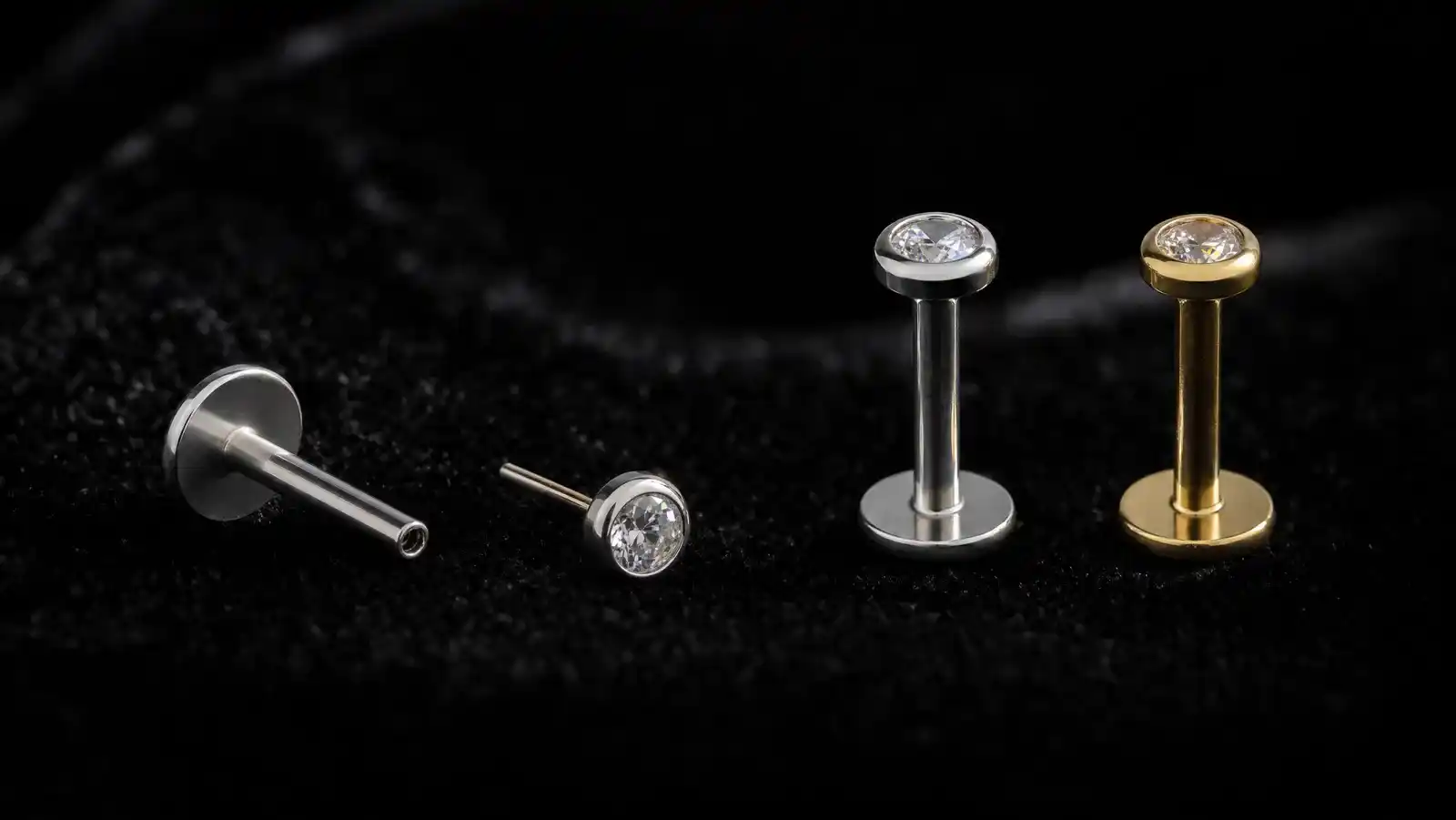
Threadless vs Threaded Earrings: Posts, Fit and Why It Matters

This post may contain affiliate links. Read our affiliate policy
Threadless vs threaded earrings comes down to a single joint: how the decorative front attaches to the post. A threadless end presses into a hollow post and is held by the spring of a slightly bent pin. A threaded end screws on, with the thread cut either inside the post or onto the outside of it.
That joint decides what passes through your ear, whether fronts from different makers will fit, and how heavy a front it can carry. It is also the spec most often missing from a listing.
All three systems turn up on flat back earring posts, at similar prices and described with the same adjectives. Here is what each one is, how to spot it in a photo, and which failure to expect from it.
How Each System Joins
The Association of Professional Piercers describes all three in a sentence each on its jewelry page for initial piercings.
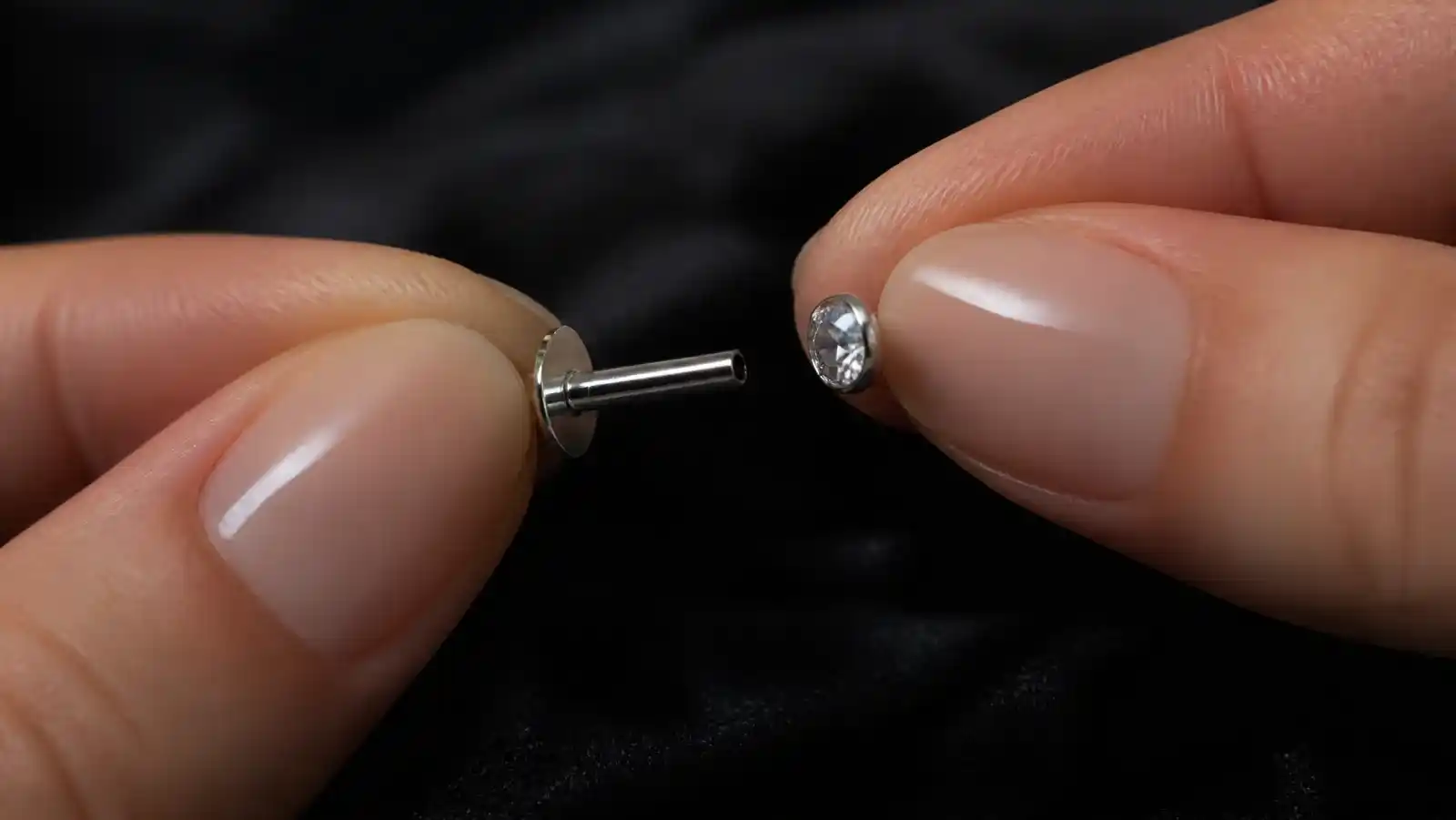
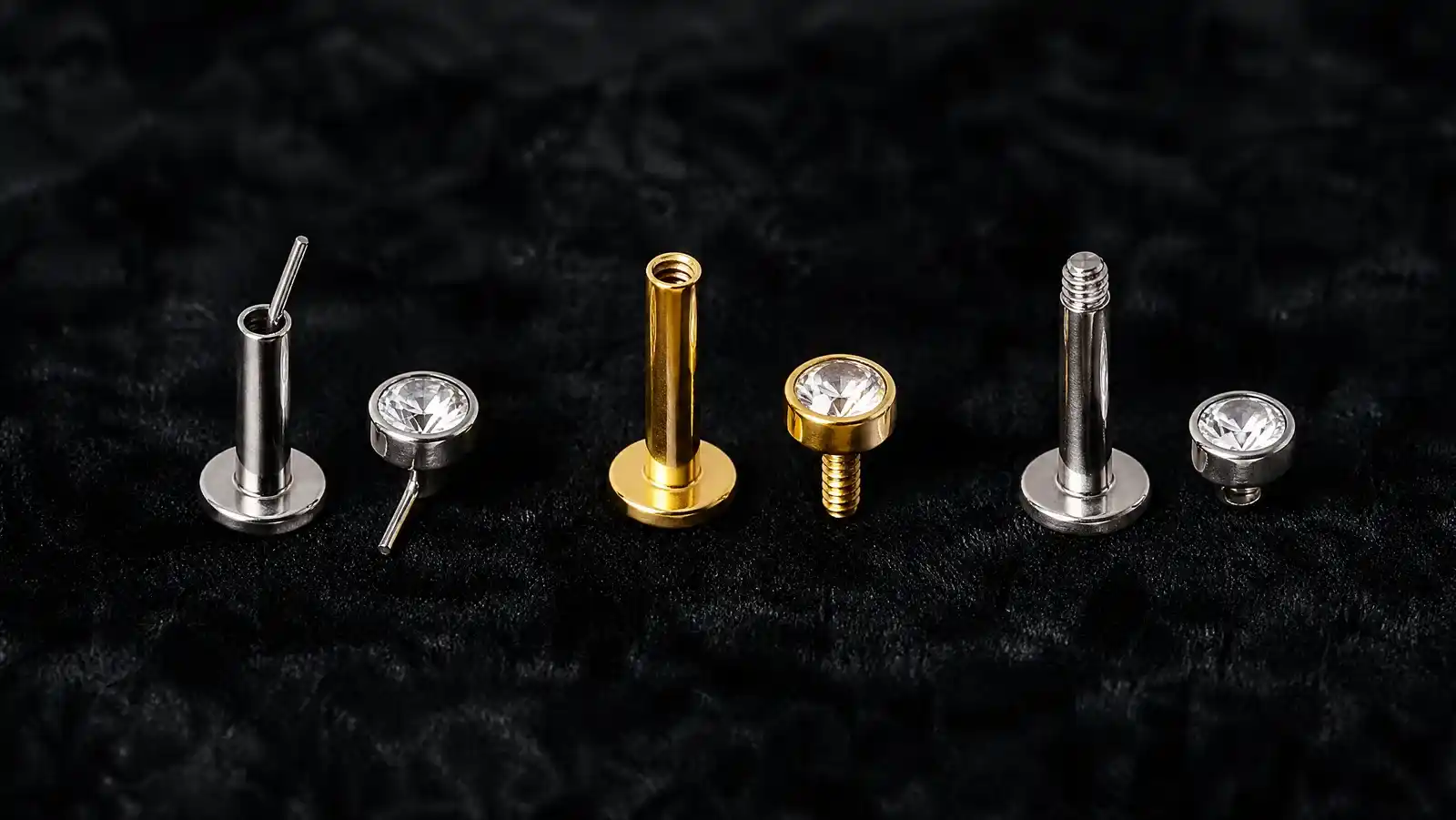
- Threadless, also sold as press-fit or push pin. The post is a hollow tube, open at the top, and the front carries a thin solid pin with no thread on it. Per the APP, threadless jewelry "uses a pin coupling on the ornamental end, and there are no screw threads at all." You bend the pin a few degrees, push it in, and its attempt to spring straight is what holds it.
- Internally threaded. The post is hollow and tapped on the inside, and the front carries a small male thread that screws down into it. The APP's stated advantage is structural: with internal threading "the part of the jewelry that passes through your skin is smooth, and the threads are on the removable end(s)."
- Externally threaded. The thread is machined onto the outside of the post and the front is tapped to receive it. In the APP's words, this version "has the screw pattern cut into the post, and this comparatively rough surface may be passed through the tissue."
Listings rarely name the system, so identify it from the loose front in the photo: a bare smooth pin is threadless, a small screw thread on the back of the front is internally threaded, and a plain socket with the thread showing on the bar instead is externally threaded.
The Pin-Bend Principle Behind Threadless Posts
Threadless is the only one of the three whose retention you set yourself.
The mechanism is documented in the original patent. US Patent 6,167,725 B1, "Threadless jewelry connector assembly", was filed on 26 June 1997 by inventor Tadeusz P. Siekierski, assigned to NeoMetal Inc, and granted on 2 January 2001. Its abstract describes "a jewelry connection system utilizing an elastic bent stem having a narrow center section" that "is inserted into a hollow tube such that binding of the stem ends in the tube creates an elastic releasable friction bond (binding) between the stem and tube pieces." A bent piece of elastic material, the patent explains, "will elastically deform to cause a wedging or clamping action" once pushed into a straight bore.
In plainer terms: the pin is trying to be straight, the tube will not let it, and that argument is your retention. Infinite Body Piercing notes that press-fit posts were "developed (and patented) by NeoMetal."
The numbers matter because you control them. NeoMetal's own pin bending guide instructs you to "insert the pin about 1/3 of the way into the shaft" and then "bend the pin between 10-20 degrees. For a tighter fit, bend slightly further."
Three consequences follow.
- Retention is a setting, not a property. Two identical pairs can hold differently because one pin has more bend in it. A front that keeps falling out is usually under-bent rather than faulty.
- Ten to twenty degrees is very little bend. A gentle curve applied with fingertips, not a kink. A visible angle is over-bent.
- The bend is consumable. Every re-bend works the same metal, and a pin straightened and re-bent many times is not the pin you started with.
For the hand mechanics of loading a bent pin, see how to put in flat back earrings.
Why External Threading Exists At All
Not because anyone argues it is better. Because it is cheaper.
Cutting a thread onto the outside of a solid bar is one lathe operation; internal tapping needs a hollow shaft and a precision thread machined into the bore. According to Painful Pleasures, internally threaded jewelry "can be slightly more expensive because it's more complex to manufacture", while externally threaded jewelry "is often more budget-friendly because it's easier to produce". The gap per unit is small, but at mass-production volume it is the whole reason the format survives, and in practice we find it concentrated in starter kits and kiosk jewelry.
The professional standard is unambiguous. The APP's jewelry standards for initial piercings require that "all threaded or press-fit jewelry must have internal tapping (no threads on exterior of posts and barbells)." That clause covers press-fit as well as threaded, which is why a reputable threadless post carries no external thread anywhere on the bar.
In at least one US city the point is written into public health law. The City of Philadelphia Department of Public Health's body art regulations permit ASTM F138 implant grade steel, solid 14K or 18K gold, titanium meeting "ASTM Ti6A4V ELI, F136", niobium and platinum, then specify that "threaded jewelry sixteen (16) gauge or thicker with external threads shall not be used." Infinite Body Piercing, a Philadelphia studio, gives the working version: "We don't use externally threaded jewelry, and its use in initial piercings is prohibited inside Philadelphia."
Read that rule closely and you find its edge. Gauge runs backwards, so 16 gauge or thicker means 1.2 mm and up, which leaves the thinnest lobe posts, 18G at 1.0 mm and 20G at 0.8 mm, outside its reach. The professional standard draws the line more broadly than the city code does.
Our own position is narrower than a ban and easier to apply. External threading drags a machined thread through the piercing channel at every change, and it is the system most often sold with no material standard named at all. If a seller will not tell you the alloy, assume they will not tell you the thread either. Anything involving a healing or irritated piercing is a question for a piercer, not a buying guide.
Thread Pitch, Pin Gauge and Why Brands Do Not Cross-Fit
This axis decides whether the spare fronts in your jewelry dish are usable or decorative.
Threaded fronts are keyed twice, to a gauge and to a thread size. Painful Pleasures' threading reference lists internal threading in 0.8 mm, 0.9 mm, 1.2 mm and 2.0 mm, pairs 0.8 mm and 0.9 mm with 18G and 16G posts, 1.2 mm with 14G and 12G, and 2.0 mm with counterbored balls from 10G to 00G. Its rule is the one to remember: "a 0.9mm internally threaded ball or jewel top will only thread onto a 0.9mm internally threaded shaft."
So a front bought for a 14G post will not fit a 16G post, and two 16G fronts from different makers can still disagree. A mismatch shows up as a stiff turn rather than a clean refusal, which is how threads get cross-threaded and ruined.
The arithmetic also explains why thin threaded jewelry is rare. Standard body jewelry size charts put 16G at 1.2 mm and 14G at 1.6 mm, and Painful Pleasures pairs 0.9 mm threading with 16G and 1.2 mm threading with 14G, so tapping a 0.9 mm thread into a 1.2 mm post leaves roughly 0.15 mm of titanium per side and a 1.2 mm thread in a 1.6 mm post about 0.2 mm. There is little wall to work with, and less at 18G. Our guide to earring gauge and post length has the full conversion table.
Threadless goes the other way, and this is its strongest argument. Pins are commonly made to 25 gauge, which standard wire-gauge charts put at 0.0179 in, about 0.455 mm, and Diablo Body Jewelry's Anatometal threadless fronts state that a 25G pin "will fit 18g, 16g, 14g, 12g Universal Threadless Posts". The same retailer's NeoMetal fronts claim three rather than four, "18g, 16g, 14g Universal Threadless Posts". One front, four post gauges, and the piercer Lynn Loheide reports the same from the chair: with threadless, "your threadless ends works in an 18, 16, or 14g post."
Two cautions. Universal is a trade description, not a standard. We can find no ASTM or ISO document governing the pin-and-bore fit; makers appear simply to have converged on a size, and pin length and bore depth still vary. And the post is the part that is not universal — nothing crosses between threadless and threaded hardware at all. Buy post and front from the same system unless the seller states cross-compatibility, and expect listings to be silent on it.
Security Under Weight: Heavy and Dangly Fronts
Here the ranking reverses, and it is pure geometry: a pin of about 0.45 mm held by friction carries the whole leverage of whatever hangs off it, and the larger the front, the longer the lever.
Piercers draw the line at a specific size. Lynn Loheide writes that "ends that are 6mm and larger typically need to be threaded for stability", adding that "that big piece on a tiny pin is just asking for disaster, and a pin to snap", and that "the stronger base and weld on threaded ends allow for a more secure connection when it comes to very large ends."
Six millimeters is five times the diameter of the 16G post such a front sits on, and about thirteen times the diameter of the pin holding it. Below that size, threadless is fine for ordinary wear. Above it, and for anything with a chain or swinging element, internal threading is the structural choice: a screw thread transmits load through engaged metal rather than a friction fit on a thin wire.
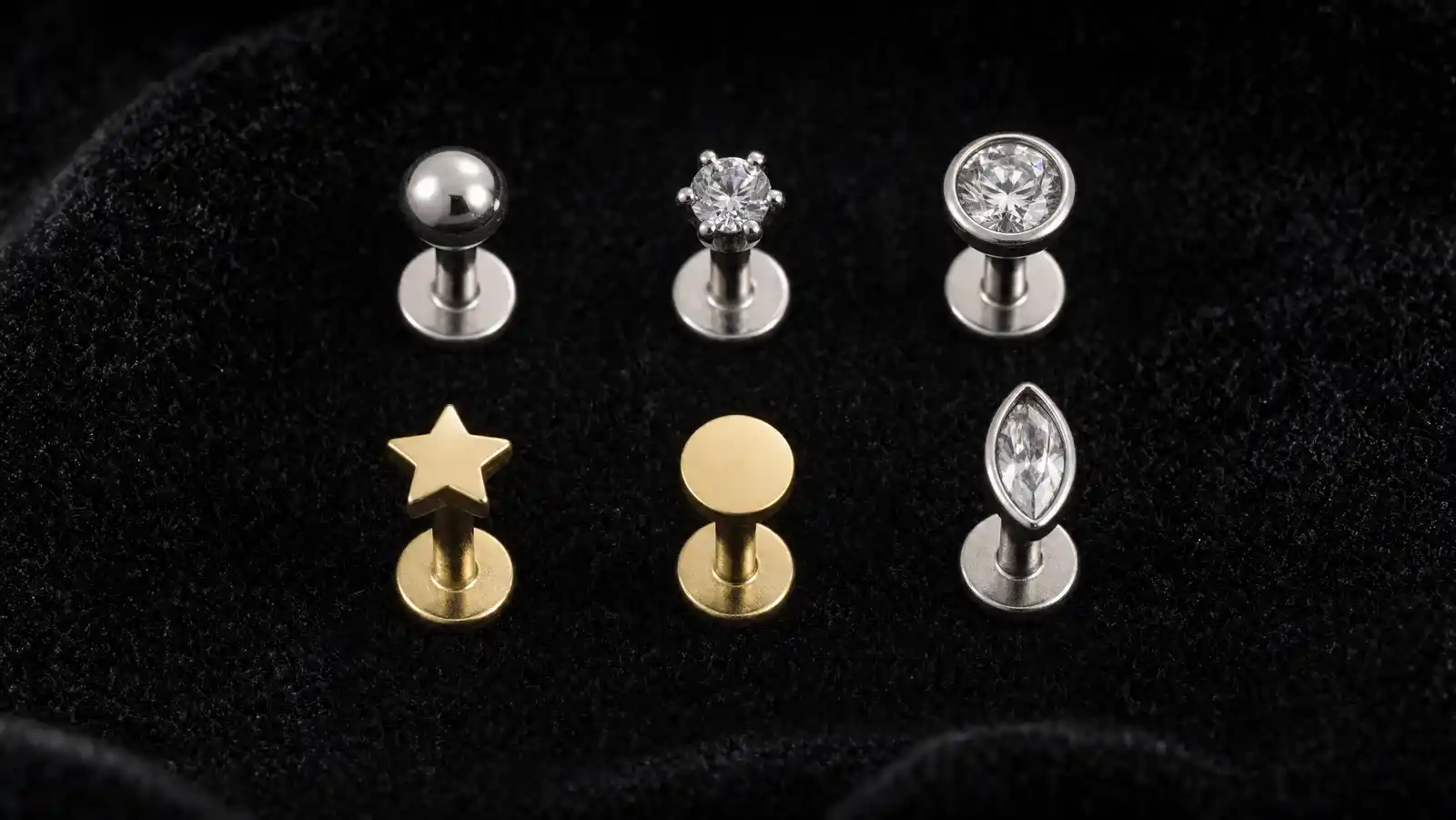
Threaded is not immune, and its failure differs. The same piercer notes that hair wrapping around a piece can unscrew a threaded end: a thread resists being pulled out, not being rotated. That distinction matters most at the heavier end of the wider range of earring shapes.
Living With Each System Day to Day
Ease of use is where threadless wins, because it removes rotation from the operation.
- Threadless: pull straight out to separate, reassemble with one push. No turning, no alignment, and possible by feel.
- Internally threaded: screw clockwise until hand-firm and no further. Fine threads on small parts cross-thread easily, and torque adds nothing but risk.
- Externally threaded: the same action, but the threaded bar is the part you push through the ear.
Both smooth-post systems have an interior that collects debris: the threadless post is an open tube, the internally threaded post a tapped bore. The APP's standards ask that surfaces "be smooth, free of nicks, scratches, burrs, and polishing compounds" and that metals carry "a consistent mirror finish on surfaces that frequently come in contact with tissue" — a condition that holds only if the parts stay clean. Our cleaning and storage guide covers the routine.
One honest caveat: Infinite Body Piercing calls press-fit pieces "some of the easiest jewelry to remove", which is a virtue at the mirror and a liability inside a sweater. Set the bend accordingly.
Failure Modes, System by System
- Threadless: the front backs out, nearly always from an under-bent pin rather than a defect; the pin snaps under an oversized front, or after being worked too many times; the front wobbles because the pin went in part way.
- Internally threaded: the thread crosses and galls when a stiff turn is forced; the front unscrews itself, turned by hair and clothing; a lost front cannot be replaced locally, because that gauge and pitch are not stocked.
- Externally threaded: a machined thread travels through the channel at every change, the exposed thread catches on knitwear, and once burred the front no longer seats.
Threadless vs Threaded Earrings, Axis by Axis
| Axis | Threadless (press-fit) | Internally threaded | Externally threaded |
|---|---|---|---|
| Surface through the ear | Smooth tube | Smooth post | Machined thread |
| How the front attaches | Push straight in | Screw clockwise | Screw clockwise |
| What holds it | Spring tension of a bent pin | Engaged screw thread | Engaged screw thread |
| Retention adjustable | Yes, by pin bend | No | No |
| Fits more than one gauge | Yes, a 25G pin spans 18G to 12G posts | No, keyed to gauge and pitch | No, keyed to gauge and pitch |
| Best front size | Under about 6 mm | Any, preferred above 6 mm | Not recommended |
| Typical failure | Under-bent pin backs out | Unscrews or cross-threads | Thread damage and snagging |
| Meets APP initial-piercing standard | Yes, with internal tapping | Yes | No |
Common Questions About Threadless and Threaded Posts
Can a threadless front go on a threaded post?
No. A threadless front needs an open bore, a threaded post needs a tapped front, and there is no adapter between them.
Why does my threadless end keep falling out?
Usually too little bend. NeoMetal's guide specifies inserting the pin about a third of the way into the shaft and bending it 10 to 20 degrees, further for a tighter fit. If the pin looks dead straight, that is your answer.
Is externally threaded jewelry ever acceptable?
Not for initial piercings: the APP requires internal tapping with no threads on the exterior of posts, and Philadelphia's regulations bar externally threaded jewelry of 16 gauge or thicker. For an established lobe you never change, it is a compromise rather than a rule violation. Ask your piercer about your own ear.
Do threadless fronts from different brands fit each other?
Often, because 25 gauge pins and so-called universal posts have converged on one size, but nothing guarantees it. No published standard we can find sits behind the word universal, and pin length and bore depth vary between makers.
Which System Suits Which Reader
Pick by what you actually do with your earrings, not by price tier.
- You change fronts often and wear small studs. Threadless. One push, no rotation, and the same front fits several post gauges.
- You wear a heavier front, a charm or anything that swings. Internally threaded, for the reason the piercing trade gives: a screw joint is the stronger base for a large end.
- You have several close placements and want a smooth bar. Threadless and internally threaded both qualify under the APP standard. Choose on front size.
- You are being offered external threading. Treat it as a signal about the whole listing: the seller who saved money on the thread usually saved it on the alloy disclosure too. If metal reactions are your concern, start from our guide to metal allergies and earring choices.
The fitting system is a compatibility decision, not a finish. A post commits you to a family of fronts, and that commitment outlasts any single earring. Decide the mechanism first, then the gauge and length, then the style.
For the whole territory in one place, materials and sizing included, read how flat back earrings work. When you are ready to shop, the titanium flat backs we recommend are read line by line against their own listings, threading system included.
About the Author
Alfreda Borror
Alfreda Borror is the founding editor of Opulent Opal, writing research-based buying guides on diamonds, birthstones, and fine jewelry.