Earring Gauge and Post Length: A Sizing Guide

This post may contain affiliate links. Read our affiliate policy
Earring gauge size is the diameter of the post, not the size of the earring, and the scale runs backwards: 20G is 0.812 mm, 18G is 1.024 mm, 16G is 1.291 mm. Lobes run 20G to 16G, depending on who pierced them. Post length, usually 6 to 10 mm, is the number that actually decides comfort.
Those two figures, plus the diameter of the disc at the back, are the whole of fit. Get the length wrong by two millimeters and you feel it every night.
This is the sizing reference for flat back earrings and conventional posts alike: where the numbers come from, what they convert to, and how to measure what is already in your jewelry box.
What Earring Gauge Size Actually Measures
Gauge measures one thing: the diameter of the bar that passes through your ear. It says nothing about length, front width or metal.
The system is borrowed from wire. Per Wikipedia's reference on body jewelry sizes, "jewelry less than 1/2 inch (13 mm) thick is typically measured in a system originally devised for measuring wire thickness" — the American Wire Gauge, or AWG — and the convention now holds whatever the piece is made of.
Four numbers describe a post earring, and a good listing publishes all four:
- Gauge — post diameter, as a number plus G, ideally with the millimeter value beside it.
- Wearable length — the usable length of the bar, and the fit-critical one.
- Disc diameter — the width of the flat plate, or the ball, at the back.
- Front size — the width of the decoration, which is cosmetic rather than structural.
Sellers publish the fourth reliably, because it photographs. The first three go missing.
Why the Scale Runs Backwards
Higher number, thinner post. The reason is manufacturing history. According to Wikipedia's article on American wire gauge, "the AWG originated in the number of drawing operations used to produce a given gauge of wire. Very fine wire (for example, 30 gauge) required more passes through the drawing dies than 0 gauge wire did."
Each pass through a die thinned the wire, so the label counted passes, and the count rose as the metal got finer. The dimensions were formalized later — "Dimensions of the wires are given in ASTM standard B 258" — and they follow the formula
d = 0.005 inch x 92 ^ ((36 - n) / 39)
which sets a constant ratio of about 1.1229 between consecutive gauge numbers. BodyCandy's gauge reference gives the working version: "the higher the gauge number, the thinner the jewelry actually is."
Body jewelry is sold in even gauges, so one catalogue step is two AWG steps — 1.1229 squared, about 1.26. Area scales with the square of diameter, so one even-gauge step up is roughly 26 percent more diameter and about 59 percent more metal in cross-section.
Gauge to Millimeters to Inches
Two sets of numbers circulate and they do not agree. The AWG nominals below are as listed in Wikipedia's body jewelry sizes reference, with 22G from its AWG table; the right-hand column is what the trade prints, per BodyCandy's published chart.
| Gauge | AWG nominal (inch) | AWG nominal (mm) | Commonly sold as | Where it turns up |
|---|---|---|---|---|
| 22G | 0.0253 | 0.644 mm | 0.64 mm | Thinnest size commonly listed |
| 20G | 0.0320 | 0.812 mm | 0.81 mm | Lobes, conventional studs, nostrils |
| 18G | 0.0403 | 1.024 mm | 1.0 mm | Lobes, flat back lobe posts |
| 16G | 0.0508 | 1.291 mm | 1.2 mm | Cartilage, labret-style posts |
| 14G | 0.0641 | 1.628 mm | 1.6 mm | Navel, nipple, heavier lobe jewelry |
Look at the 16G row. Elsewhere the rounding is trivial, every drift under 0.03 mm. For 16G, the market label of 1.2 mm sits 0.09 mm below the AWG nominal of 1.291 mm, a gap of about 7 percent. Both labels are in daily use: Infinite Body Piercing lists NeoMetal press-fit labret posts as "16g (1.2mm)", and Maison Miru's sizing page states that "most piercing jewelry is 16g (1.2mm) or 18g (1.0mm)."
Buy by gauge number and read the millimeter figure as a label, not a measurement.
The Three Gauges That Matter for Ears
Ignore most of the chart. For ears the working range is three sizes.
- 20G (0.81 mm). The thinnest of the three. Listings commonly show it on mass-market fashion studs, and BodyCandy's reference gives 20G or 18G as typical nostril sizes.
- 18G (1.0 mm). A standard lobe size. That chart lists earlobes at 20G or 18G, and cartilage at 16G.
- 16G (1.2 mm). The cartilage workhorse, and the size most labret-style posts are built around. The same chart gives 16G for septum and lip placements.
Thicker gauges are not ear sizes. BodyCandy lists 14G as the common navel and nipple gauge, so 14G in a lobe listing is a spec to query.
Thinner is not gentler either. The Association of Professional Piercers, in its jewelry standards for initial piercings, requires that jewelry "must be of an appropriate gauge (thickness)" and states the reason without softening it: "the body may treat jewelry that is too thin in gauge like a splinter, resulting in migration or rejection."
What gauge your ear is depends on what pierced it — a question for the piercer who did the work. It is also where shortlisting the best cartilage earrings begins, since lobe and cartilage jewelry are frequently not the same size.
18G vs 20G Earrings: What 0.21 Millimeters Changes
The gap between 20G and 18G is 0.212 mm on the AWG nominals. Two tenths of a millimeter, and it still decides fit.
- It is 59 percent more cross-section. From the values above, 1.024 divided by 0.812 is 1.26; squared, 1.59.
- The thinner post moves in the wider hole. A 20G post in a channel made at 18G has clearance all round, so the front tips and the stud sits crooked.
- It does not work in reverse. You cannot put 1.0 mm through a 0.8 mm channel without stretching tissue, and whether that suits your ear is a piercer's call, not a purchasing decision.
20G and 18G are not a quality tier. They are two different holes.
Post Length: The Spec That Decides Comfort
Post length is where almost all fit complaints live, and it is quoted as wearable length — the part that has to span your ear.
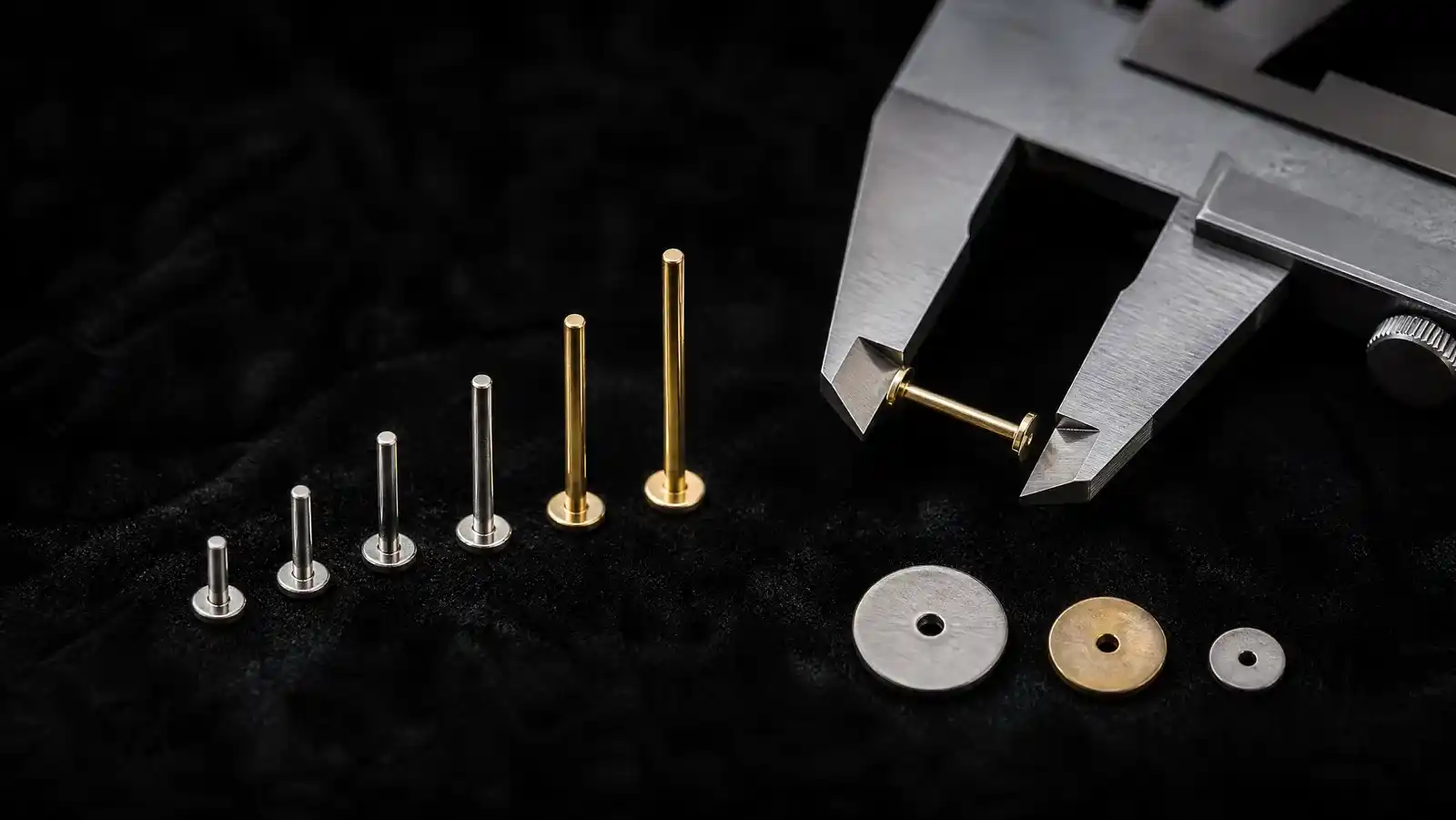
Maison Miru's sizing page defines it as "the distance from the front piece to the backing," and adds the figure worth memorizing: "6mm is the most common length." BodyCandy's measuring guide states the rule as an instruction: "measure the space from the base of one threaded end to the base of the other. Do not include the length of the balls or any part of the threading that sticks out."
Tissue thickness varies across a single ear. Maison Miru's placement table reflects that: helix jewelry is offered in 6 mm and 8 mm, conch in 8 mm and 10 mm. The stocked range says the same — Infinite Body Piercing lists NeoMetal press-fit posts in nine lengths from 3/16 inch to 1/2 inch, which is 4.76 mm to 12.7 mm.
No universal length exists: the one that fits your lobe is probably wrong for your conch.
What Too Short and Too Long Actually Do
Too short: the APP's standards require that jewelry "must be of appropriate length or diameter for your unique anatomy and the placement of the piercing," because "jewelry that is too tight does not allow for air and blood circulation or for the expulsion of normal secretions from the piercing." The APP's two-sided summary: ill-fitting jewelry "increases the likelihood of swelling, embedding, and other complications if too small, or catching and excessive trauma, if too large."
Too long: the consequence is mechanical. Brilliance Piercing, explaining why shorter posts get fitted during healing, notes that a longer post left in while you sleep "can start to shift the angle of it," and associates repeated snagging with irritation bumps.
In a healed ear you are feeling for three things: the disc sits flat without pressing in, the front does not rock, and no bare shaft shows. Anything sore, swollen, weeping or embedded belongs with a piercer or a clinician — a sizing guide cannot assess your ear, and we are not going to pretend otherwise.
Post Length in Inches: A Conversion Table
American-made body jewelry is often machined and listed in fractional inches, then converted by the retailer — not always the same way. Infinite Body Piercing's NeoMetal post listing runs from 3/16 inch to 1/2 inch; shorter 5/32 inch posts appear in other catalogues.
| Listed as | Exact millimeters | Often printed as | Typical use |
|---|---|---|---|
| 5/32 inch | 3.97 mm | 4 mm | Very short, thin lobes |
| 3/16 inch | 4.76 mm | 4.8 or 5 mm | Snug lobe |
| 7/32 inch | 5.56 mm | 5.6 mm | Lobe |
| 1/4 inch | 6.35 mm | 6 or 6.4 mm | The common lobe length |
| 9/32 inch | 7.14 mm | 7.1 mm | Thicker lobe |
| 5/16 inch | 7.94 mm | 8 mm | Thick lobe, helix, flat |
| 11/32 inch | 8.73 mm | 8.7 mm | Helix, flat |
| 3/8 inch | 9.53 mm | 9.5 or 10 mm | Conch, thick tissue |
| 7/16 inch | 11.11 mm | 11 mm | Longer initial fit |
| 1/2 inch | 12.70 mm | 12.7 mm | Longest standard |
Two traps. A "6 mm" post is often a 1/4 inch post, which is 6.35 mm — a third of a millimeter longer than advertised. A "10 mm" post is often 3/8 inch, which is 9.53 mm, nearly half a millimeter shorter. When two sellers give different figures for the same fraction, neither is lying; they rounded differently. When a listing gives inches only, convert before you buy.
Disc Diameter: 2.5, 3, 4 and 5 Millimeters
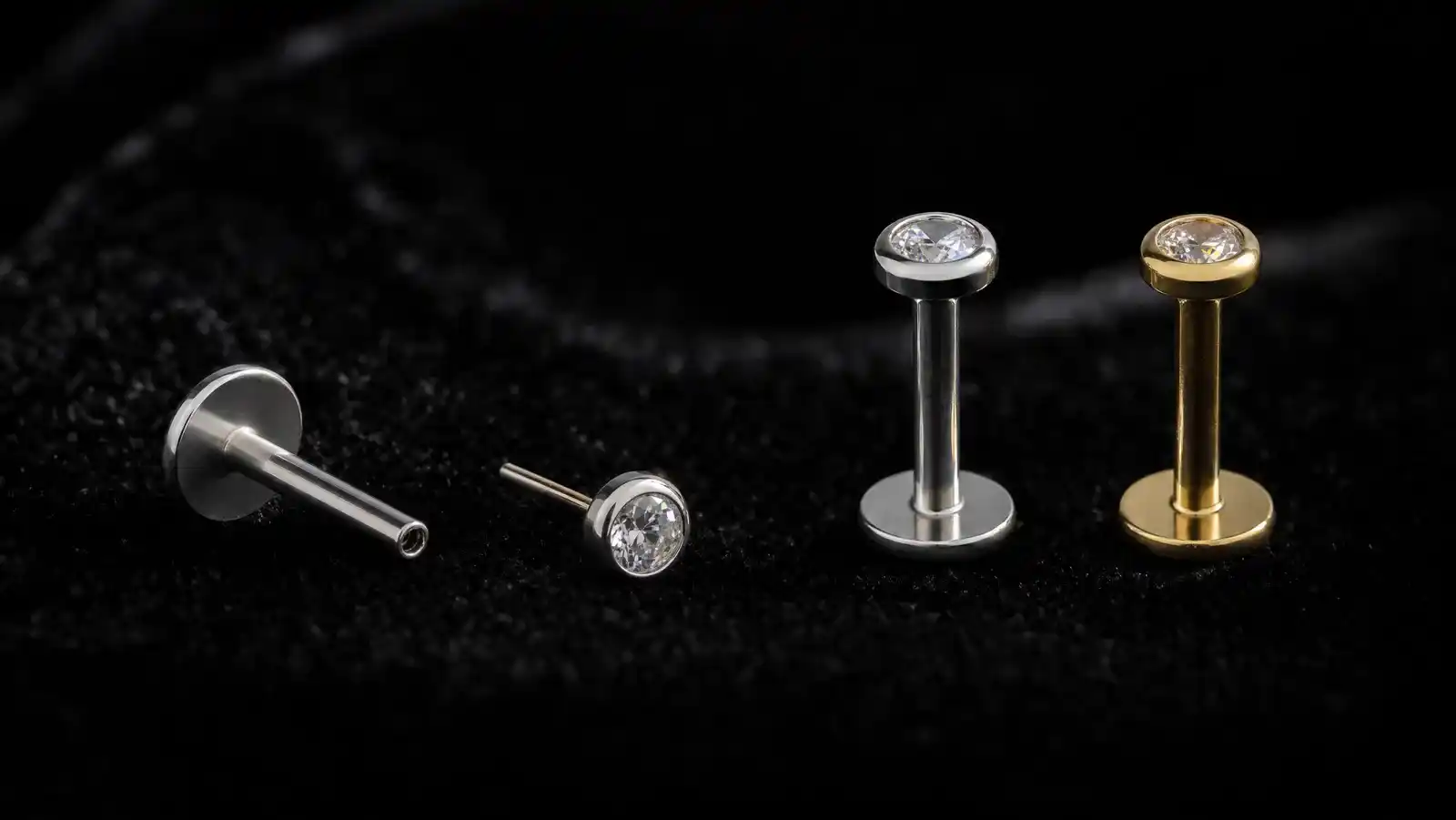
The disc is the flat plate at the back of a labret-style post, and it is the spec most often omitted. Listings for threadless posts commonly offer 2.5 mm, 3 mm, 4 mm and 5 mm, with 4 mm a frequent default: Infinite Body Piercing's NeoMetal listing states that "each post comes with one attached 5/32 inch (4mm) disk" — and 5/32 inch is 3.97 mm, so even the disc carries a rounding.
Disc size is a pressure calculation. Bearing area scales with the square of diameter, so a 4 mm disc spreads the same load over 2.56 times the area of a 2.5 mm disc.
- Wider is for load and pressure. Heavier fronts and thicker tissue both benefit.
- Narrower is for clearance. Closely spaced piercings, and confined placements such as the tragus, need a plate that will not collide with its neighbor.
One well-fitted post can carry many looks, since the front is the only part you change. Our rundown of earring shapes and designs covers what to put on it.
Downsizing: Why the First Post Is Deliberately Too Long
If your initial jewelry felt too long, it probably was, on purpose. The follow-up fitting is called downsizing.
Brilliance Piercing defines it as practiced: "downsizing is done before a piercing is fully healed by swapping a longer post out for a shorter one to minimize the potential for snags and trauma." Its stated timings differ by placement — an earlobe "may or may not need a downsize around 6-8 weeks," while a helix or conch "will need a downsize at 6-8 weeks."
Early on, extra length accommodates swelling, because jewelry that is too tight restricts circulation and traps secretions. Once swelling resolves, that same length becomes the problem: a shaft that protrudes is a shaft that catches.
Keep the long post — it is your only record of the gauge and disc size your piercer selected. And the timing is not yours to judge from a chart; every source above treats downsizing as an appointment.
How to Measure What You Already Own
The most reliable size reference is a post you already wear comfortably.
Wearable length. BodyCandy's sizing guide asks only for "a ruler that has millimeter markings," and its rule is the one above: end to end of the bar, excluding balls and any protruding threading. On a flat back post that means base of the disc to top of the shaft. Take the piece out first — how to put in flat back earrings covers removal without fighting the disc.
A length you do not own yet. Maison Miru's method: "insert a standard post and mark where you'd like the jewelry to sit. Remove it and measure that length with a ruler." Their tie-breaker is sound — "when in doubt, size up" — because extra length is an inconvenience while a post that will not close is unusable.
Gauge. A millimeter ruler cannot do this: the whole difference between 20G and 18G is 0.21 mm, below what printed graduations resolve. Use digital calipers, compare against a post of known gauge, or ask your piercer.
Write down gauge, wearable length and disc width, measured at its widest point, and that is the specification you shop with from then on. Keeping the pieces you rotate out clean and findable is its own discipline, covered in our notes on cleaning and storing what you take off.
How to Read a Listing That Omits the Spec
We read a lot of listings. Most publish the front diameter, the metal in marketing terms, and nothing else.
A listing worth buying from gives the gauge in both G and millimeters, the wearable length, the disc diameter, and the material against a standard. Infinite Body Piercing's post listing is the shape to look for, specifying posts "machined from a solid piece of implant-grade titanium (ASTM F136 6Al-4V ELI)". A fifth spec, the joining system, decides whether a front will fit the post at all — the differences between threadless and threaded posts are worth knowing before buying ends and shafts separately.
How to handle the gaps:
- "Fits standard piercings" is not a gauge. There is no standard. Ask, or buy elsewhere.
- A lone millimeter figure is ambiguous. "4 mm" usually means the front, occasionally the disc, almost never the post.
- Material claims without a standard are claims. "Surgical steel" and "nickel-free" are not specifications; ASTM F136 is. For how the metals compare if your ears react, see our guide to metal allergies and earring choices.
- The photo answers what the text does not. A loose front shown beside the post reveals whether the joint is a smooth press-fit pin or a cut thread.
Common Questions About Earring Gauge and Post Length
What gauge are most earrings?
For ears the working range is 20G (0.81 mm), 18G (1.0 mm) and 16G (1.2 mm). BodyCandy's reference gives 20G or 18G for earlobes and 16G for cartilage, and Maison Miru states that most piercing jewelry is 16G or 18G.
What post length should I buy for a helix?
Maison Miru lists helix jewelry in 6 mm and 8 mm, and conch jewelry in 8 mm and 10 mm, which brackets the usual range. The exact number depends on your tissue, so measure a post that already fits.
How do I tell whether my post is 16G or 18G?
Measure it with digital calipers or compare it against a post of known gauge. The difference is about 0.2 mm, which a millimeter ruler cannot resolve, and the trade labels of 1.0 mm and 1.2 mm are rounded rather than exact AWG dimensions.
The Bottom Line
Gauge is post diameter, and it runs backwards because the AWG scale counted drawing operations rather than thickness. For ears that means 20G, 18G and 16G — nominally 0.812 mm, 1.024 mm and 1.291 mm under ASTM B258, rounded by the trade to 0.8, 1.0 and 1.2.
Before you buy anything:
- Confirm the gauge of the piercing, from your piercer or with calipers.
- Measure the wearable length of a post that already fits, disc base to shaft top.
- Choose the disc from clearance and front weight: 2.5 to 3 mm for tight spacing, 4 mm as a default.
- Convert any inch figure yourself, and check that front and post share one joining system.
Three numbers, written down once, and the guesswork is over. For how they fit into choosing the jewelry itself, including materials and standards, see our guide to flat back earrings.
About the Author
Alfreda Borror
Alfreda Borror is the founding editor of Opulent Opal, writing research-based buying guides on diamonds, birthstones, and fine jewelry.